
Attractor point in DesignScript
This is my first try at DesignScript syntax. It is quite easy to understand and on-screen reference help seems to work well. It creates regular AutoCAD entities when you run. One of the most important concepts of this language is said to be a kind of associativity that updates objects when any parameter is changed while the script is running. However such associativity is not possible after the script has finished running. If you want to use the regular imperative style, you should use directive [imperative] in the script to tell it that variables are not actively associative. Unfortunately, I couldn’t find a suitable use of this associativity as DesignScript seems to want itself to be run endlessly. I’m a little disappointed about it because as far as I remember, even Generative Components had the ability to interact with the user via object translations. Maybe I’m doing something wrong here.
import("ProtoGeometry.dll");
import("Math.dll");

// Create a square grid of points
point_x = 0..100..#10;
point_y = 0..100..#10;
points = Point.ByCoordinates(point_x<1>, point_y<2>, 0);

// Define a random attractor curve
attract = Point.ByCoordinates(Math.Rand(0,100),50, 0);

// Create circles on the grid that reacts the attractor
circles = Circle.ByCenterPointRadius(points, points.DistanceTo(attract) / 15);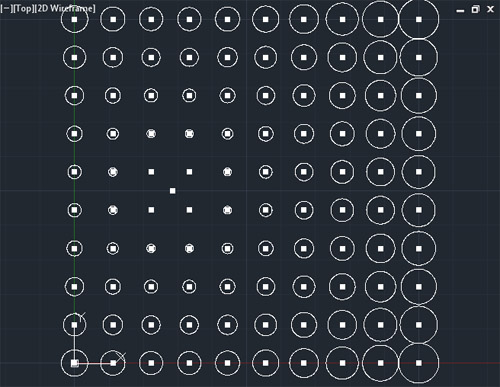
Cite this post
Related Posts
Custom Graphics on VPL
January 10, 2012
This was an interesting challenge for me to find out if an architect can use Visual Programming Languages (VPL’s) also for graphical purposes? Now, I would say “not exactly” because this definition took much time than I expected. The aim was to create an algorithm for a business card design that has variable outputs. Each card should be different, but without using any randomization. This project is suitable for more development because now it is only producing one sequence of…
Field Deformation
October 8, 2026
Ever since I restructured designcoding, I’m still sorting through the trash folder. All 580 posts published on the blog have been reviewed, and their files have been uploaded as open source. The mysterious trash folder, where I couldn’t even tell where things belonged, is shrinking fast. While checking this folder yesterday, I found a video. This is probably a simple tutorial I prepared about 10 years ago for the parametric modeling elective course (probably related to this 2012 post). The…
Basic Grid Deformation
July 5, 2023
I am still trying to find the simplest solution to some geometric definitions. This is why I called this Grasshopper definition “Basic Grid Deformation”. Here you see the Curve Proximity (CrvProx) component in use. This component calculated the shortest distance between two curves. I think the underpinnings of this component are very interesting. I hope I can code it in Python one day. In order to see the result more clearly, the Previews of the Interpolate Curve (IntCrv) and Square…
Attractor Basics
June 29, 2023
In this short tutorial, I want to give Grasshopper beginners the basics of how we create attractor systems. The Grasshopper definition you see in the below figure is the equivalent of array-type copying operations in CAD. However, unlike in CAD programs, here we are dealing with multiple generations of objects rather than transformations. Attractor Basics: Data Matching In the application you see in the figure below, each row of the hexagonal grid created with HexGrid has a different radius value….
Point Waves
May 29, 2023
Here is another basic exercise in Grasshopper. This exercise “Point Waves” creates wave-like deformations on the grids of points. The major function of the definition is to calculate the distances from every point of a grid to an attractor point, with the help of Distance (Dist). Then it sorts them from the smallest to the largest (= closest to farthest) with the Sort List (Sort) component. This component takes and matches two lists of the same size, called key (K)…