designcoding
About Table of Contents Keywords Monthly Archive
Support designcoding!

#pattern

50 posts

Bits and Pieces

November 2, 2013

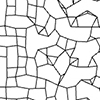
Below are some of the student works from the 4th-week exercise Bits and Pieces of this semester’s Basic Design studio. The gestalt notion of “figure-ground phenomenon” refers to the characteristic organization of perception into a figure that ‘stands out’ against an undifferentiated background. What is figural at any one moment depends on patterns of sensory stimulation. And on the momentary interests of the perceiver. Thus, the figure-ground relationship is an important element of the way we organize reality in our…

Karyokinesis

November 2, 2013

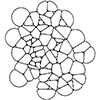
While searching for a way to work with random points and growing populations, this idea appeared accidentally. I wasn’t trying to mimic the behavior of Karyokinesis of biological cells (in fact I’m in serious doubt about biomimicry in general). The trick is to use a timer + data recorder + a knob for the arbitrary user input. It starts to breed when you start the timer, but to change the evolution speed, just roll the knob!  Of course, the knob…

Spiral of Random

October 21, 2013

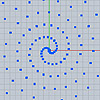
Grasshopper still surprises me. This definition draws a spiral by using a random component. It is obvious that the seed value of the random component has a relationship with an archimedean or a similar spiral. My intention was to create a definition to put a number of random points inside a circular area, not a rectangular one. While I grow the radius of a circle and get a t parameter evaluation from a random component using the same seed value…

I at the Center

September 30, 2013

I at the Center is a multiple-axes vertex deformation based on a quadrangular hyperframe, designed by David Oleson at the studio of William Huff in 1964. Below, you see the original drawing and my Grasshopper animation based on a single-point attractor, creating the “I” wherever it is. It was a pleasure to read and repeat this deformation, which is a nice exercise in data tree operations and also one of the first examples I see about point attractor algorithms in design…

Crossover Parquet Deformation

August 20, 2013

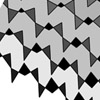
It has been a while since I didn’t post any patterns. Here is a beautiful one from the iconic design studio of William Huff. Crossover Parquet Deformation is a single-axis, line-based deformation algorithm, constructed on a regular quadrangular hyperframe, designed by Richard Lane at the Basic Design studio of William Huff in 1963. It presents two different parquet deformation sequences linked together. Thus, the designer created a transition between the borders and inner cross-shapes gradually. This transition is visually smooth…

Truchet Patterns

June 21, 2013

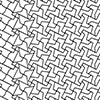
Below is a classical Truchet Patterns example we used to discuss in design computing class. Now, we can create a much faster and cleaner definition using the newly added Array component. The new version of Grasshopper brings several important features: Patch surfaces and date/time components. We used to implement a VB component to create simple clocks that measure temporal operations in Grasshopper. Parsing and executing MusicXML and related applications were based on that. Now I see there is a whole…

Patronus

May 29, 2013

The exploration of the concept of “patronus – pattern” in architecture is presented in a captivating and insightful manner. This issue of AD, although older, continues to hold relevance in the contemporary realm of architectural design, covering various aspects of the conception and utilization of patterns. It’s comprehensive analysis and thought-provoking discourse shed light on the intricate relationship between patterns and architectural form, unveiling the potential for pattern-based design approaches to shape and enhance built environments. This is why this…

Trifoliolate

April 30, 2013

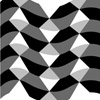
The Parquet Deformation exercise is generally originated with William Huff. Huff conducted it at several schools of architecture since the 1960s. Huff defines the exercise as rooted in two analytical disciplines; monohedral tilings in geometry, and the continuous deformations in biological morphology. This is generally exemplified by D’Arcy Thompson’s and Albrecht Dürer’s studies. One of the student’s works of Huff, Trifoliolate is a single-axis, single-prototile hexagonal parquet deformation. It was designed by Glen Paris at the studio of William Huff…

Hofstadter’s Objection

March 8, 2013

After explaining the beautiful parquet deformations of William Huff, Douglas Hofstadter states his opinions about the algorithmic potentials of those patterns. Although it was 30 years ago, Hofstadter points out a fundamental discussion related to today’s parametric design tools; …for a machine to make simple variants of a given design, it must possess an algorithm for making that design which has explicit parameters; those parameters are then modifiable, as with the pseudo-Mondrian paintings. But the way people make variations is…

Infections Workshop

January 29, 2013

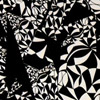
The series of workshops named “gridal infection”, or “infections” in short, explore the multiplicity of pattern deformation in a pedagogical context. It aims to encourage design students to manage an associative process of design, composed of short-term constructive assignments. Students are expected to develop an understanding of contemporary computational design techniques regarding a connection between abstraction and conceptualization. It reflects an open discussion of the abstract types and methods of potential infections on any pre-defined system while the geometric representation of…

« 1 2 3 4 5 »
  • Chapters

    • Algorithms
    • Discourses
    • Fabrications
    • Studios
  • Explore

    • All Keywords
    • Table of Contents
    • Monthly Archive
    • #paper
    • #design-competition
    • #snub-square
    • #octahedron
    • #packing
    • #fourier
    • #moulding
    • #non-euclidean
    • #grid
    • #bezier-curve
    • #muqarnas
    • #spiral
    • #nesting
    • #macro
    • #dual
    • #pvc-hose
    • #simulation
    • #concrete
    • #quad
    • #geodesic
  • Search

  • Support designcoding!

  • Enjoying designcoding? Support me on Patreon to keep it growing. Thank you!

  • copyright 2026 designcoding.net | about | privacy policy | end user license agreement