
Solid and Void Exercise
This was last week’s Basic Design II exercise at İstanbul Bilgi University, a captivating challenge that pushed students to explore the realm of solid and void compositions using pre-defined components. The objective was to construct intricate structures that intertwine solids and voids in visually striking ways. Recognizing that these compositions may be intricate and difficult to comprehend solely through visual outputs. The students were encouraged to prepare Rhino models as tools for explaining their construction processes. However, despite their best efforts, the students encountered some difficulties in elucidating the intricate rules of construction step-by-step.
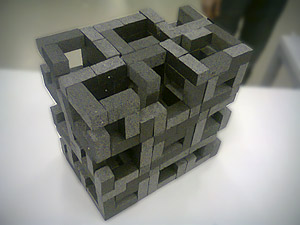
In exercises like this, the journey of creation often holds greater significance than the final outcomes themselves. It is through the process of experimentation, discovery, and problem-solving that students truly immerse themselves in the subject matter. The preliminary results of this exercise were undeniably intriguing. They undeniably required further refinement and refinement. It is important to note that this exercise serves as a foundational introduction to the studio. Expecting complete mastery and control at this stage may be premature.
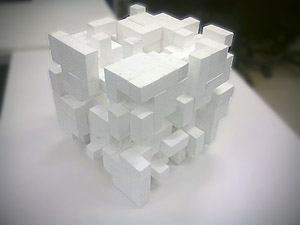
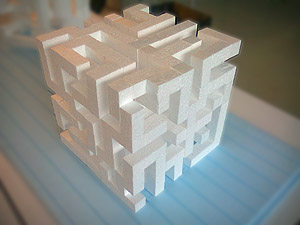
Nevertheless, the students displayed commendable dedication and enthusiasm throughout the exercise, diligently pushing the boundaries of their creativity. By embracing the iterative nature of design, they acknowledged the need for continuous improvement and refinement. Undoubtedly, with additional work, revisions, and guidance from their instructors, these students will further develop their compositions, honing their skills and gaining a deeper understanding of the complexities of solid and void relationships.
As the exercise drew to a close, the students remained motivated, recognizing the potential for growth and the importance of perseverance in their creative endeavors. The invaluable lessons learned from this exercise will undoubtedly serve as a solid foundation for their future architectural explorations.
Cite this post
Related Posts
Earthbound
August 14, 2026
Rammed earth is an unpredictable, labor-intensive building material, and far less durable than concrete. It cannot deliver the standard strength expected by engineering academia. And perhaps it is for the better that it cannot. Because it tells us an entirely different story. It reminds us architectural thinking that dares to look outside the box. What I want to share here, is not just a simple studio project, but a profound life lesson for many of us here, lived in the…
PLURA Pavilion
September 22, 2026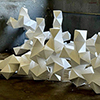
Last year, during the first stage of the Architectural Design Graduate project, our student team made a quick preparation and participated in the experimental works exhibition at the International Antalya Architecture Biennale (IABA 2025). This was a challenging yet educational process for our team. Using EPS foam and the robotic hotwire cutter (RHWC), a production run of 125 units, consisting of two modules (95 octahedra and 30 icosahedral units), was carried out. The icosahedral units also underwent an additional cutting…
Hydrophilic Structures
June 6, 2019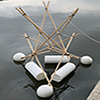
Hydrophilic Structures is the 2018-2019 Spring Semester Graduate Studio of the Architectural Design Program. The studio aims to increase the public interaction with water, while being sensitive to the ecological and historical context of the shores of İstanbul. Students will be encouraged to design sustainable, floating modules and structures, which can be integrated into semi-open architectural programmes. A full-scale prototype will be fabricated and tested at the Santral Campus coast to Haliç. The main conceptual framework of the studio consists…
Spacebound
September 24, 2026
Let’s take a closer look at the midterm jury assignment for our “Field & Matter”- themed Computation-based Basic Design 2 studio, which I conducted last year alongside Serkan Uysal, İpek Kuran, and Sinan Logie. I shared the studio’s final project, Earthbound, in a previous post. In this post, we will focus on our process-oriented midterm project named Spacebound. Topography as a Data Field In this first major phase of the “Field & Matter” studio, we examined how moving and stationary…
New Year Lanterns 2018
January 9, 2018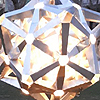
This year’s Computation-based Basic Design Studio finals were very successful. Below are some of our student’s design works, and lanterns that light the campus area at İstanbul Bilgi University. It was a great experience for them to seek a design system between the domains of material computation and architectural geometry. 28 first-year students of architecture, interior design, and industrial design completed their projects in groups of 4. Students: Aleyna Demirkök, Aleyna Yıldız, Ali Hayder Ali Al Obaidi, Ara Yerlikaya, Aybike Sarıgül, Ayşe…