
Rumi Improvizations
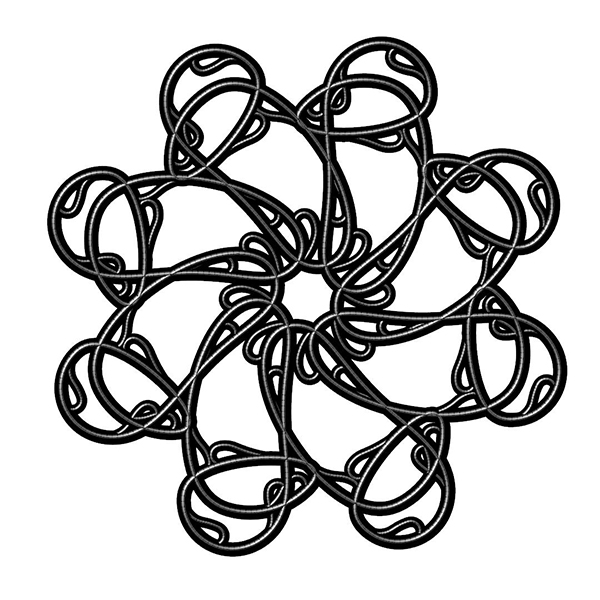
In this short study, I generated Rumi Improvizations. The rumi motif, prevalent in traditional Turkish decorative arts like tilings, window lattices, and fabrics, features a round shape with a comma-like body. Despite resembling stylized leaves, rumis have zoomorphic origins. Rumi compositions depicted stylized animal figures, including birds, lions, deer, fish, and mythical creatures like dragons and Simurg. They symbolized strength, fertility, and the eternal struggle between good and evil. The oldest rumî-like animal shapes were discovered on rugs found in southern Siberia, dating back to the 4th century B.C. However, the earliest examples of complete rumîs are dated to 8th-century frescoes of Uyghur Turks. In these frescoes, rumi is on the wings of sea creatures. The Seljuks brought the motif to Anatolia, naming it after the region. The term “rumi” signifies Anatolian or belonging to Anatolia, as the Anatolian peninsula was “Diyar-ı Rum” during the Eastern Roman Empire. Anatolian Seljuks extensively utilized rumi between the 11th and 14th centuries. Then, over time, as the Ottomans embraced Islam, the motif lost its zoomorphic roots and shamanistic meaning, evolving into an abstract shape.

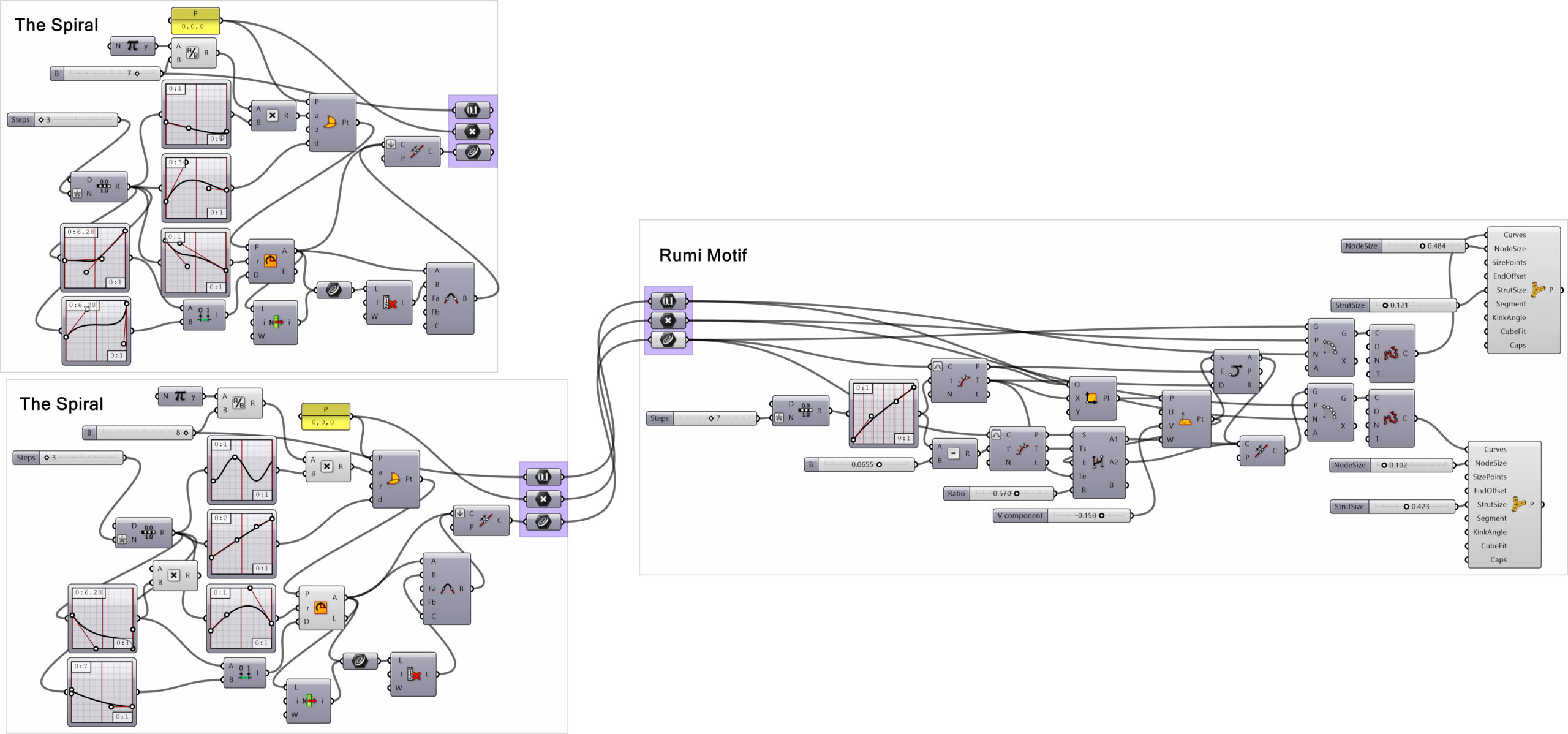
This Grasshopper definition generates Rumi-like compositions. It is possible to play with the Graph Mappers to explore new designs. The output of the definition is a set of curves and sub-d surfaces. The code is using native Grasshopper components. Therefore, no add-ons are necessary for it to work.
Cite this post
Related Posts
Fibonacci Portraits
December 27, 2023
“In the heart of a sunflower’s embrace, its seeds weave a poetic tale—a dance of two spirals, parastichies they’re called. One unfurls gracefully from the center in the hush of clockwise whispers, while its counterpart whispers secrets in the tender breaths of counterclockwise motion. A subtle ballet unfolds, where the number of these spirals gracefully mirrors the whispers of adjacent Fibonacci numbers, composing a delicate symphony in the sun-kissed fields.” says ChatGPT if I force it to be a little…
String Art in Rhino Python
June 19, 2025
String art is a cool art technique that combines geometry and aesthetics to recreate images using lines between pins. Here is a good reference to start studying it. In this post, I explored a custom Rhino Python script designed for Rhinoceros 7 and 8. It transforms a grayscale image into a dense web of threads. The algorithm analyzes the darkest areas of the image and connects pins in a circular layout to form compositions. The script begins by converting a…
Parametric IQlight
August 23, 2024
Holger Strøm designed the famous IQlight system in 1973. After more than 50 years, it is still a popular, innovative, and smart design. The IQlight is a self-assembly lamp composed of interlocking quadrilaterals. By utilizing polyhedral geometry, you can generate various shapes and sizes. I created a model of one of the most common IQlight designs, fitting it onto the Catalan solid known as the rhombic triacontahedron. This solid is a convex polyhedron with 30 rhombic faces, making it an…
Archimedean Pendants
July 11, 2024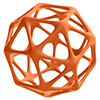
Today’s polyhedra are the famous Archimedean Solids! I created a simple Grasshopper script to generate pendants from these beautiful solids. I call this Archimedean Pendants. However, you can implement other polyhedra to the same code. I hardcoded the vertex coordinates so you won’t need an extra add-on to generate the polyhedra. Thanks to the new SubD component Multipipe, it makes life much easier to produce 3dprint-ready results. To make this definition more useful, you can add scale operations in all…
Lissajous Pendants
February 9, 2024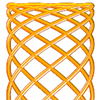
Lissajous curves, named after the French physicist Jules Antoine Lissajous are a family of curves that emerge from the interaction between two harmonic oscillations. They have applications in various fields including physics, engineering, and signal processing. They are commonly used in electronic devices such as oscilloscopes to visualize the phase relationship between two oscillating signals. Similarly, they are also useful in mechanical engineering for analyzing and designing mechanisms that involve harmonic motion. Lissajous curve functions can help in understanding the…