designcoding
About Table of Contents Keywords Monthly Archive
Support designcoding!

Archimedean Spirals

December 17, 2012
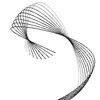
In this exercise, Grasshopper draws various Archimedean spirals. It constructs polar points and maps them onto a range of angles and a number of points. The spiral’s turning speed is determined by the constant “a,” while the constant “n” gives unique names to the spirals by raising the angle variable to the power of 1/n. Wolfram Mathworld names the spiral with n = -2 as lituus, n = -1 as a hyperbolic spiral, n = 1 as a regular Archimedes…
Back to Macro

December 14, 2012

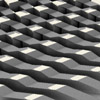
Can we go back to the beginnings of algorithmic design tools, when it was still as simple as possible (not to the binary level of course)? Most of the theorists agree about the fact that contemporary parametric design tools sometimes provide needlessly many possibilities that suppress the designer’s own creativity. The Voronoi component in Grasshopper was one of the cult examples of that (mentioned here). Throughout this blog, I always search for simple and powerful definitions to design problems, without…

3D Pattern Deformation

December 12, 2012

These are examples of 2.5D exercises in the design geometry course in my freshman year of architecture. We asked students to create extruded or referenced solids referenced from their previous exercise of pattern deformations, (examples are here and here). We also started to inject some of the most used concepts of design computing here, by perceiving each tessellation cell as the variation of a predefined algorithm, such as a relationship with an attractor object (a distance value with a point)….

A Diagram (Sometimes) Worth Ten Thousand Words

December 12, 2012

Here is an interesting phrase from Jill Larkin and Herbert Simon’s famous article. It is “Why A Diagram (Sometimes) Worth Ten Thousand Words”; The phrase from the article My Thoughts on “A Diagram…” While perusing this text, I found myself curious about the correlation between “formal languages,” “algorithmic architecture,” “scripting,” and “problem-solving” and why we teach them together. The introduction to these subjects occurred during my enrollment in the Shape Grammars graduate course. Over the past decade, a fascinating re-connection…

Scripting Tab in Rhino 5

December 11, 2012

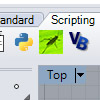
Last year, I posted a way to create a Grasshopper command button in Rhino 4 (here). As the scripting possibilities increase in Rhino 5, the new tab feature can be used to put them together. I’ve made 4 of the most used platforms in a tab named “Scripting”. Here is how I did it; Use right-click on the empty area to open the above menu and select “new tab” to create an empty tab, naming it “Scripting. Right-click on the…

Variable Voronoi Study

November 30, 2012

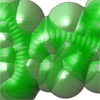
I’ve been searching for a method to study the Voronoi subdivision in order to manipulate it. There are well-known algorithms for that. But I thought it would be better if I use a projective approach just as I did in studying hyperbolic space (here). This is the metaphor of inflating balloons. However, I inflated cones instead of spheres. This way, it became possible to modify the algorithm. So I was able to develop a kind of variable Voronoi study here….

Spherical Attraction

November 28, 2012

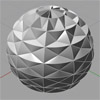
Today’s Architectural Geometry course was about platonic solids and different attractor objects in introducing component-based design systems. Benay’s idea was both pedagogical and interesting to test in Grasshopper. I searched for the most fundamental type of attractor solid in creating a composition such as this; There is a subdivided sphere and an attractor sphere. The pull component works great here. You may use multiple attractor solids or different shapes such as platonic solids as attractors. It is quite an easy…

Seamless Patterns

November 23, 2012

In this exercise, we asked students to develop a method to produce custom tessellations. This is based on the analysis of what is called “Islamic patterns”. We have discussed Eric Brough‘s famous book “Islamic Geometric Patterns”, regarding geometric relationships and linear connectivities via underlying tessellations (such as regular square and hexagonal). Thus, this geometry and drawing exercise is called “Seamless Patterns” in the Design Geometry course at İstanbul Bilgi University. By taking this brief, students generated patterns along with their…

Tangent Circles Exercise

November 19, 2012

The first-year Architectural Geometry course includes Euclidean constructions as a study of associative geometry. We have exercised the below questions to study this topic. These are three mutually tangent circles, that can be drawn using only a compass and ruler, without built-in tangency functions in Rhino. Such exercises are expected to improve students’ reasoning. We believe architectural geometry education should encourage a conception that allows students to think about what they are doing and control their process, rather than just…

Attractor point in DesignScript

November 19, 2012

This is my first try at DesignScript syntax. It is quite easy to understand and on-screen reference help seems to work well. It creates regular AutoCAD entities when you run. One of the most important concepts of this language is said to be a kind of associativity that updates objects when any parameter is changed while the script is running. However such associativity is not possible after the script has finished running. If you want to use the regular imperative…

« 1 2 3 … 33 34 35 36 37 38 39 40 41 42 43 44 45 46 47 48 49 50 51 52 53 … 55 56 57 »
  • Chapters

    • Algorithms
    • Discourses
    • Fabrications
    • Studios
  • Explore

    • All Keywords
    • Table of Contents
    • Monthly Archive
    • #fibonacci
    • #hoopsnake
    • #regulations
    • #icosidodecahedron
    • #concrete
    • #non-euclidean
    • #brick
    • #firefly
    • #attractor
    • #text
    • #designcoding
    • #phyllotaxis
    • #dürer
    • #music
    • #stone
    • #ice-ray
    • #wood
    • #space-filling
    • #solar-analysis
    • #tangent
  • Search

  • Support designcoding!

  • Enjoying designcoding? Support me on Patreon to keep it growing. Thank you!

  • copyright 2026 designcoding.net | about | privacy policy | end user license agreement