designcoding
About Table of Contents Keywords Monthly Archive
Support designcoding!

Parametric Wall Exercise

April 19, 2013
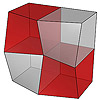
This is a first-year design computing problem we studied last month. It is a simple parametric wall exercise introduced by Mete Tüneri. Creating a simple definition of a building brick to be placed on a straight path, and then manipulating the path to reform different variations of the brick. This aims to introduce a fundamental concept of associativity in contemporary architectural geometry and design computing. Students are then encouraged to develop their own parametric brick to be tested in different…
Porous Solids

April 16, 2013

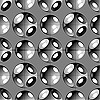
This is a solid-void (or boolean) exercise for first-year students. It is initially introduced by Onur Yüce Gün as an in-class exercise but later became a design problem also. Before getting into the parametric wall and eventually muqarnas exercises, this small but effective assignment helps students understand some of the fundamental concepts such as associativity, solid/void relationships, and component-based design compositions in three dimensions. Here is the initial object we used to introduce in the design computing class: As you…

Binary Branching using Macro

April 15, 2013

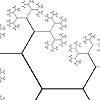
Today’s design computing class was about fractals. In Rhino, writing macro statements are very easy to learn as it just mimics your behaviors in a sequential text. There are a few syntactic rules that we should know. First, you should watch the command line carefully to understand the steps of your design process. Each command in Rhino requires different inputs from the user. In macro, you may enter these values or tell the macro to ask the user by typing…

Chinese Ice-ray Lattices Revisited

March 25, 2013

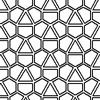
One of the cult texts in Shape Grammars theory is Stiny‘s Chinese Ice-ray Lattices Grammars. Although it is full of technical terms, it represents an analysis of a working algorithm. We can directly transfer that from the behavior of an artist. One can imagine a Chinese artisan, summoned to a building site. He brings tools and implements and a collection of finely finished sticks. Then, he begins his design by selecting a stick of the appropriate length and carefully attaching…

Swirly Flames

March 20, 2013

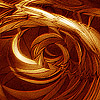
One of the main requirements of being successful in the field of digital design seems to have nice high-tech background images. Usually, it contains different kinds of nebula-like grids, plastic-explicit, and/or combinations of curves-surfaces-and-numbers, burnt by a couple of photoshop filters. If you have the right background, this means you are ready for a workshop, a book, or a presentation. (just joking) However, I love these, and cannot stand more than 1 minute working for them. So, here is what I…

Maxscript Table

March 20, 2013

Maxscipt can be used to automate specific modeling tasks in a sequential-parametric way. This example, developed in 2005 shows an example of that. It creates various table designs by polygon modeling operations and asks the user various parameters. Below is the interface of the script; There are preset parameters in a dropdown box, and all other available parameters are organized in rollouts. Here are some default results of the script. It is not as fast and smart as the Grasshopper…

Terminal 2002

March 20, 2013

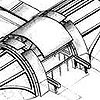
This month became a retrospective for me. This was my first animation, prepared for the CAAD Graduate course of Ahmet Turan Köksal in 2002. It was an inspiration from SDF-1 of Robotech. The terminal model is my graduation project at YTU Faculty of Architecture in 2001. It was a terminal bus project for İstanbul modeled in AutocadR14. I mirrored it with a ground plane to create the space station. Other spaceships and grape-like houses are done with Rhinoceros 3.0 (again, they were my…

Techne Epistinio Poiesis

March 16, 2013

Below is a part of Heidegger’s famous text, “The Question Concerning Technology”, on Techne, Epistinio, Poiesis; Revealing “… We are questioning concerning technology, and we have arrived now at Aletheia, at revealing. What has the essence of technology to do with revealing? The answer: everything. For every bringing-forth is grounded in revealing. Bringing forth, indeed, gathers within itself the four modes of occasioning – causality – and rules them throughout. Within its domain belonging to end and means belongs to…

Truchet Tiling

March 13, 2013

This elegant and straightforward tiling geometry is credited to Dominican priest Sebastien Truchet in 1704 and was documented in a book titled “Memoir sur les Combinasions” (A Memoir on Combinations). After delving into the renowned Truchet Patterns in 2013, I revisited their three-dimensional tiling counterparts today. This served as a valuable exercise in geometry during my previous Design Geometry course. I believe it enhances one’s proficiency in mastering the technical aspects of Rhino software and in creating seamless tilings through…

Hofstadter’s Objection

March 8, 2013

After explaining the beautiful parquet deformations of William Huff, Douglas Hofstadter states his opinions about the algorithmic potentials of those patterns. Although it was 30 years ago, Hofstadter points out a fundamental discussion related to today’s parametric design tools; …for a machine to make simple variants of a given design, it must possess an algorithm for making that design which has explicit parameters; those parameters are then modifiable, as with the pseudo-Mondrian paintings. But the way people make variations is…

« 1 2 3 … 29 30 31 32 33 34 35 36 37 38 39 40 41 42 43 44 45 46 47 48 49 … 55 56 57 »
  • Chapters

    • Algorithms
    • Discourses
    • Fabrications
    • Studios
  • Explore

    • All Keywords
    • Table of Contents
    • Monthly Archive
    • #rhombicosidodecahedron
    • #text
    • #facade
    • #vector-field
    • #arduino
    • #canopy
    • #simulation
    • #macro
    • #logic
    • #computational-geometry
    • #voronoi
    • #photoshop
    • #cube
    • #landscape
    • #galapagos
    • #icosahedron
    • #golden-ratio
    • #bezier-curve
    • #dürer
    • #cairo-pentagonal
  • Search

  • Support designcoding!

  • Enjoying designcoding? Support me on Patreon to keep it growing. Thank you!

  • copyright 2026 designcoding.net | about | privacy policy | end user license agreement