
Lesion
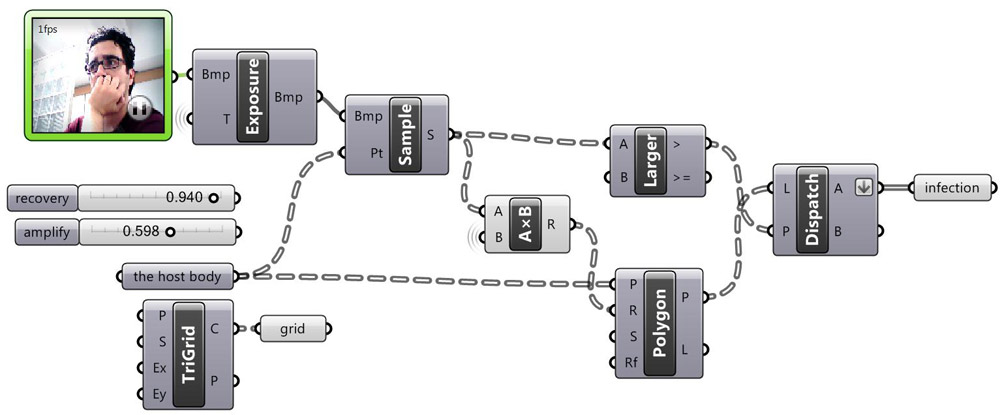
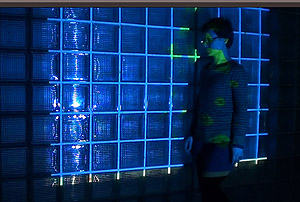
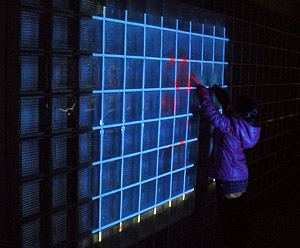
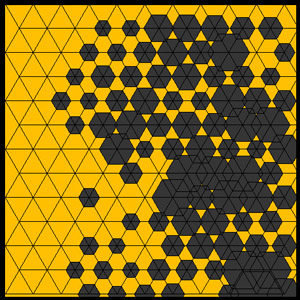
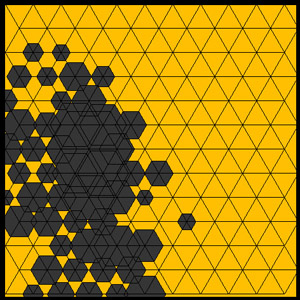
This is another final project of the three-day workshop at YTU, named Infections. A conceptual framework is developed by Bahar Aybudak (METU) and Zeynep Gür (ITU). The cellular forms come together to set the existing wall (host body). The wall represents the body structure, in which in case of any infection, various challenges could be seen in parallel with the immune system. The struggle with the mentioned infection is observed through various transformations in these cells. The location in which these transformations occur is not static but changes according to the infected area (lesion) of the body. Depending on the surrounding movements, some parts are becoming infected and lesions occur. Eventually, infections are pushed away from the cells in the lesion and a time-based recovery process starts. However, the host body isn’t the same anymore. The parametric definition is based on the visual tools of Firefly (Rhinoceros 5.0 64-bit is not supported). The above ideas of the students are realized by implementing a history-based truncation process on a regular grid (see figures below). The truncation is associated with the movement vectors of Firefly. As it is a time-based algorithm, there are parameters such as “recovery” and “immune system”.
Cite this post
Related Posts
Infections v2 @ Bolu
April 26, 2013
The “Re_Flex Patterning” workshop will be conducted at İzzet Baysal University Faculty of Engineering and Architecture between 6-8th May 2013. The workshop is led by Tuğrul Yazar and Fulya Akipek, from the İstanbul Bilgi University Faculty of Architecture. Integrating digital media with the material world reveals emergent performances. Parametric modeling techniques encourage designers to study more on the envelopes of potentials instead of singular artifacts. Working with these envelopes tells a design cycle that entails the determination of relations and…
Plasma
February 8, 2013
This is the third and the last project of the Infections workshop conducted at YTU this week.The conceptual Framework is developed by Betül Dönmez (DEU). In this project, the host body is infected by high fever and pressure and changes its solid phase into plasma. The solid molecules of the existing body transform to become plasmatic. This substance can react to various movements around it. When someone comes close to the wall, the plasma molecules start to get into motion, unify, expand,…
Infections Workshop
January 29, 2013
The series of workshops named “gridal infection”, or “infections” in short, explore the multiplicity of pattern deformation in a pedagogical context. It aims to encourage design students to manage an associative process of design, composed of short-term constructive assignments. Students are expected to develop an understanding of contemporary computational design techniques regarding a connection between abstraction and conceptualization. It reflects an open discussion of the abstract types and methods of potential infections on any pre-defined system while the geometric representation of…
Fiber Grid
February 8, 2013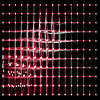
This is one of the three final projects of the Infections workshop at YTU. The conceptual framework is developed by Begüm Aktaş (YTU) and Merve Özhan (BAU). According to them; the existing host body is a 16×11 unit glass brick wall, which is constructed to separate the corridor of the faculty and to create semi-private spaces for various activities. In this project, the host body is considered the dead tissue of an organism. Sound is considered an injection that changes…
Strings
January 17, 2014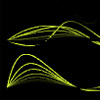
Here is a test of the optical flow component of Firefly. You can check the Firefly add-on to Grasshopper here. As an ongoing research project, I’ve been searching for a suitable platform to study responsive geometric patterns. This initial study focuses on one particular effect of Firefly, the optical flow that outputs the direction vectors on a given webcam input. I developed traces of it by joining endpoints of these vectors together, creating strings. Then, recorded them to provide better…