designcoding
About Table of Contents Keywords Monthly Archive
Support designcoding!

Discourses

71 posts

The First Grasshopper Book in Turkish

August 1, 2017

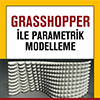
Together with Serkan Uysal, we pubished a comprehensive guide to Grasshopper. The book is in Turkish and is currently published by Pusula. Grasshopper (GH) is a plug-in running on the Rhinoceros (Rhino) modeling software. It is used for algorithmic form-finding and real-time parametric modeling. This book presents techniques aimed at architects, interior designers, industrial product designers, jewelry designers, and anyone interested in exploring parametric and algorithmic modeling for hobby purposes. Anyone who wishes to discover dynamic and unconventional geometric forms…

Leveling in Dataflow

March 26, 2015

This is a great book, explaining very familiar concepts of dataflow diagrams for designers firsthand. Leveling is an interesting chapter there, I’m not sure if it completely fits with the use of “Clusters” in Grasshopper but it is obvious that the complex systems should be well organized not only to be perceptually “better” ones but also to develop a way to use parts of definitions again and again in different situations. …How do you actually DO the leveling of DFDs? The…

CAD Smart Objects

May 23, 2014

Another Turkish translation from my Ph.D. The paper is titled “CAD Smart Objects: Potentials and Limitations”, presented by Magdy Ibrahim, Robert Krawczyk, and George Shcipporeit at the 21st eCAADe Symposium in 2003. It is a brief introduction to today’s CAD and BIM concepts. You can find this paper in CuminCAD’s database. Below is the Turkish version, which I translated in 2005: CAD SMART OBJECTS: POTENTIALS AND LIMITATIONSMagdy Ibrahim, Robert Krawczyk, George Shcipporeit Özet Yıllardır, BDT (bilgisayar destekli tasarım; Computer Aided…

Nonlinear Architecture

May 23, 2014

This is my Turkish translation of the 1997 article by Charles Jencks, “Nonlinear Architecture: New Science = New Architecture?”. Very short but the cult text explains the emergence of a new technology-based architecture. Although very old, it is still an up-to-date discussion for computational design research. NON-LINEAR ARCHITECTURE: NEW SCIENCE = NEW ARCHITECTURE ? Charles Jencks Yüz yıldan beri pekçok mimar yeni oluşan yaşam koşullarının yeni bir mimarlığı doğuracağını söylemişlerdir. İronik olarak, bu söylemler Modernistler tarafından gelenekselleştirilmiş, ancak zaten bilinen…

On the Patterns of Digital Design

March 24, 2014

Here is a good brief explanation by Mark Garcia on how patterns re-emerged in the digital age after Modernism and Postmodernism. …In the 1980s and 1990s, Postmodernist patterns predominated, and especially those of Robert Venturi, Rem Koolhaas, Stan Allen and Sanford Kwinter (fields), along with historicist, folding, sprawl, cross-programming, high-density/proximity, non-places and other Deconstructivist and high-tech patterns. In 1992, Henri Lefebvre’s last book Rhythmanalysis: Space, Time and Everyday Life was published. Because Lefebvre’s keystone concept of ‘rhythm’ is identical to…

Difference and Repetition

December 25, 2013

Here is a phrase from Deleuze’s famous article “Difference and Repetition”. It clarifies my mind while thinking about patterns, boundaries, rules, and most importantly, the idea and techniques of deformation in contemporary architectural geometry. … On the other hand, generality belongs to the order of laws. However, law determines only the resemblance of the subjects ruled by it, along with their equivalence to terms which it designates. Far from grounding repetition, law shows, rather, how repetition would remain impossible for…

Euclidean Construction for Dummies

October 31, 2013

Here is a simple explanation of the famous Euclidean Constructions: Why didn’t Euclid just measure things with a ruler and calculate lengths? For example, one of the basic constructions is bisecting a line (dividing it into two equal parts). Why not just measure it with a ruler and divide by two?One theory is the the Greeks could not easily do arithmetic. They had only whole numbers, no zero, and no negative numbers. This meant they could not for example divide…

Infections: Parametric Patterning and Material Behavior

September 12, 2013

This is our eCAADe paper with Fulya Akipek, explaining our 2013 Workshop series called “Infections”. Contemporary trend of the computational design education is grounded on an integration of domains such as fabrication technologies, material studies, and generative techniques. This requires not only an intuitive handling on digital tools and methods, but also an experience on material and production constraints simultaneously. Patterning emphasizes a material shift in the generative side of the digital paradigm, and a geometric shift in the material…

First Year Design Exercises 2006-2007

September 3, 2013

This paper presents the beginnings of my journey into architectural education, presented at Yıldız Technical University Architectural Education Symposium 2007, together with YTU/CADU staff; Ela Çil, Birgül Çolakoğlu, Meral Erdoğan, Fulya Akipek, Oya Pakdil, and Şebnem Yalınay. It includes different exercises from various studio instructors,  all motivated by contemporary computational design theory. This was one of the milestones in the first year of education of a computation-based studio in Turkey, which we’re sustaining at İstanbul Bilgi University Basic Design studios…

Albrecht Dürer

July 22, 2013

In the 14th century, Albrecht Dürer basically seems to capture some of the fundamentals of contemporary parametric design. Apart from other thinkers of his age, he refused to accept one single definition of beauty, based on proportions. His famous physiognomical studies reflected very early examples of referential systems that generate diverse design outputs, even a half-century before Descartes published the coordinate system and four centuries before D’Arcy draw the formal studies on species. I don’t know if he is mentioned…

« 1 2 3 4 5 6 7 8 »
  • Chapters

    • Algorithms
    • Discourses
    • Fabrications
    • Studios
  • Explore

    • All Keywords
    • Table of Contents
    • Monthly Archive
    • #weaire-phelan
    • #sandblasting
    • #complex-number
    • #rhombicosidodecahedron
    • #hyperbolic-paraboloid
    • #hyperbolic
    • #muqarnas
    • #folding
    • #cuboctahedron
    • #interlocking
    • #unity
    • #nesting
    • #icosidodecahedron
    • #wood
    • #responsive
    • #sinan
    • #fibonacci
    • #non-euclidean
    • #relief
    • #phyllotaxis
  • Search

  • Support designcoding!

  • Enjoying designcoding? Support me on Patreon to keep it growing. Thank you!

  • copyright 2026 designcoding.net | about | privacy policy | end user license agreement