
On the Digital ReConstruction of Muqarnas
Together with Sevde Dinçer, we published a new study on the digital reconstruction of muqarnas. This is also Sevde’s ongoing Ph.D. topic. Previously, she started studying muqarnas geometry in her master thesis under the supervision of Togan Tong. Then, she advanced her studies in this field. Eventually, my contribution to this study was about redefining and comparing the three major modeling approaches. Apart from that, the case study, literature research, and all the rest were done by her.
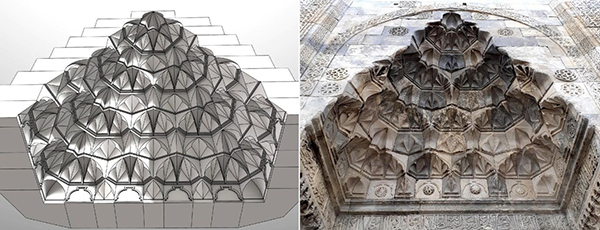
This paper presents a comparative case study on the digital modeling workflows of a particular muqarnas system. After the literature review, we defined several digital modeling workflows. These are element-based, tessellation-based, and block-based workflows. We tested them on a muqarnas located at the Sultanhanı Caravanserai in Central Anatolia. Then, we compared the workflows according to three qualities: analytical, generative, and performative. The outcomes of the element-based workflow have more analytical solutions for the study, where tessellation-based workflow has more generative potential and block-based workflow is more performative.
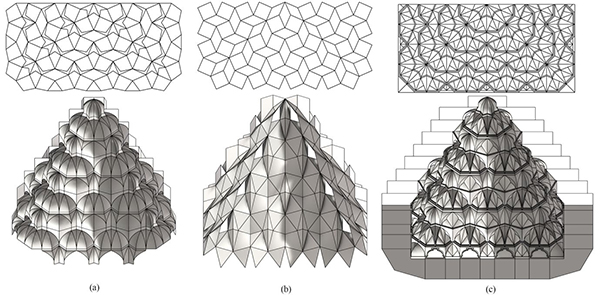
Here is the paper. The block-based model especially interests me. Because it also attempts to explain the underlying structure. This is a distinguishing feature of Seljuk muqarnas. Although there are many studies on the geometric analysis of muqarnas, it is still an active research field. There is no single method or solution that is capable of explaining every instance. This methodological diversity leads to a rich research field. As an alternative to the most common element-based approach, we proposed two new modeling workflows. We expected these workflows to help examine the relationship between mathematics and architecture with a new and fresh look.
Cite this post
Related Posts
Parametric Muqarnas Blocks
January 9, 2024
While reviewing past Grasshopper studies, I stumbled upon a Parametric Muqarnas study dating back 11 years. Although it shares numerous characteristics with a muqarnas design, it is not a perfect match. The Grasshopper definition used in that study was not particularly efficient, prompting me to revisit and improve it. This particular design presents various challenges, making it an excellent exercise for mastering Grasshopper. My goal with this study was to create Parametric Muqarnas Blocks suitable for 3D printing. To achieve…
Parametric Muqarnas
March 13, 2012
This was an interesting topic in design computing class. Geometric constructions based on strict relationships are becoming exciting in parametric modeling environments. I think muqarnas includes such a relationship. There is a primary method of modeling this shape, introduced by Mete Tüneri. His solution to a simple parametric muqarnas object includes a surface with six reference points, with two boolean differences (one cylinder and one box) creating the component. In Grasshopper, I tried to simulate his process by adding real-time…
Robotic EarthCrafts II
April 1, 2025
Robotic EarthCrafts II occurred in the summer of 2024 at Istanbul Bilgi University, seven years after the first. Together with Fulya Özsel Akipek, Nilüfer Kozikoglu, Abdullah Mallah, and Halit Mallah, we experimented with the robotic fabrication of molds for rammed-earth structures. The focus shifted toward a human scale based on the experience gained from Robotic EarthCrafts I. At the workshop’s core were spatial systems resembling muqarnas, which incorporated non-planar geometric transitions. Unlike the first workshop, we utilized a parametric model to design and generate robot…
Muqarnas Student Works
April 26, 2013
In Design Computing class, we have discussed how the parametric wall study (here) can be implemented to describe regular curved surfaces such as domes. This led us to well-known design compositions named Muqarnas. Previously we have studied how a parametric muqarnas definition could be in Grasshopper (here). After a couple of weeks of study, students started to capture the idea of generating seamless surfaces out of a few components. Of course “Designing your own muqarnas” is a tough question. Here…
Perseverance
October 8, 2026
While digging through my trash archives, I found this video from three years ago. Instead of exploring things with Grasshopper, I jumped into a bit of naive digital art. The Fibonacci Sphere algorithm was very popular in those days. I used the SubD components, which were new at the time. It was around the same period as the one right over there. I tried to make something scary again, but to be honest, there is also quite a depressive mood…