
Perseverance
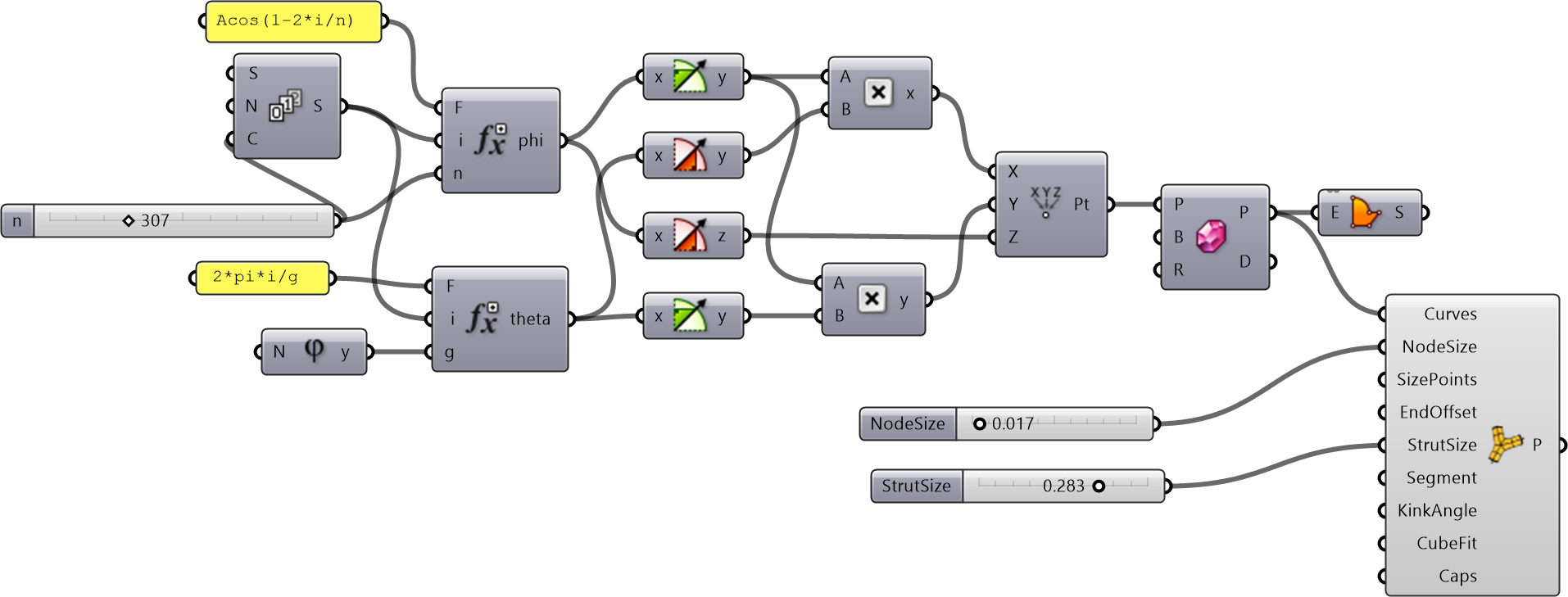
While digging through my trash archives, I found this video from three years ago. Instead of exploring things with Grasshopper, I jumped into a bit of naive digital art. The Fibonacci Sphere algorithm was very popular in those days. I used the SubD components, which were new at the time. It was around the same period as the one right over there. I tried to make something scary again, but to be honest, there is also quite a depressive mood here. That period was really difficult for me. I tried to express it in the environment I knew best. Everyone can go through times like these, right?
It was like trying to draw breath inside a cage, struggling not to drown. You must keep your head held high, keep breathing, and so your eyes must be cast upward. No matter what, you must never look down, never look back. For we tend to drift toward where we gaze. And should you begin to fall, you already know too well there is no bottom. As a dear friend once put it, one had to endure. Not merely wait with patience, but fiercely persevere.

Cite this post
Related Posts
Fibonacci Sphere
April 12, 2023
This website explains the problem and several solutions. I managed to implement the formulas to convert a 2D square grid into spherical coordinates. The Fibonacci Sphere is one of the solutions to the equal distribution of points on a sphere. It is not the best solution to this problem. But it is regarded as a quick and efficient one. Suitable for me. I developed this Grasshopper code by studying the above website and some other sources. The code starts with…
Gaussian Curvature
September 23, 2026
The development of geometry began by measuring the world as discrete objects. Moving beyond measuring nature, it evolved into reasoning, calculation, and mathematics. Platonic solids were one of the most elegant and beautiful ideas reached by geometry. Pondering why there are only five of them was a tribute to collective human intelligence. Earlier in this blog, we modeled polyhedra, like the Platonic solids, using geometric construction methods. This process was like solving a puzzle. To construct a point whose distances…
Fibonacci Dome
March 1, 2024
This is the continuation of my previous study on the Fibonacci lattice on a spherical surface, creating a Fibonacci Dome structure. The panelization of curved forms with flat surfaces has been a favorite topic in architectural geometry. The trigonometric layout of the Fibonacci sequence generates a spherical formation, while the Faceted Dome component handles planarity. Here, I further enhanced the previous code into a pavilion design. The essential part of the code is about the placement of points on the half…
Spherical Cycloid
April 2, 2024
Today’s beautiful curve is the spherical cycloid. It is a cycloid, rolling on a 3d circular path rather than a straight and 2d one. There are algebraic explanations of this curve. Therefore, I find it interesting to experiment with them, since it is more interesting than the regular planar cycloids, epicycloids, and hypocycloids. This curve is believed to have been studied first by Jean Bernoulli in 1732. The interesting and playful part of this is the resulting curve is always…
Spherical Attraction
November 28, 2012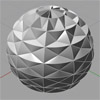
Today’s Architectural Geometry course was about platonic solids and different attractor objects in introducing component-based design systems. Benay’s idea was both pedagogical and interesting to test in Grasshopper. I searched for the most fundamental type of attractor solid in creating a composition such as this; There is a subdivided sphere and an attractor sphere. The pull component works great here. You may use multiple attractor solids or different shapes such as platonic solids as attractors. It is quite an easy…