
SpaceChase for Grasshopper
The SpaceChase plugin for Grasshopper focuses on initiating dynamic capabilities to Space Syntax theory by introducing the “Dynamic Canvas” model along with real-time editing capabilities in an interactive physics-based environment.
SpaceChase is a software development project for “Mekan Dizimi Tasarım Uygulaması” under the ARDEB 1001 program of TÜBİTAK. It is a collaborative research project between İstanbul Technical University, İstanbul Bilgi University, and Tuşpa Design Studio. You can find more information about the project here. In SpaceChase, a Kangaroo-based dynamic graph is introduced along with contextual node and edge types. You can manipulate the dynamic graph through node and link manager GUIs, coupling Space Syntax metrics with node behavior, and various other options for adjusting the physical properties of the dynamic nodes and edges.
Graph measurements and analyses such as Justified Tree Graph, Mean Depth, Relative Asymmetry, Real Relative Asymmetry, Integration, Control, Connectivity, and Choice are available in the current version. You can access most of the internal properties of the nodes through analysis components for further calculations. Additionally, an implementation of Dijkstra’s shortest path algorithm is available. Currently, the plugin is a GHPY assembly, written in Python. The SpaceChase plugin for Grasshopper combines Space Syntax analysis methods with Kangaroo to provide an interactive dynamic model.
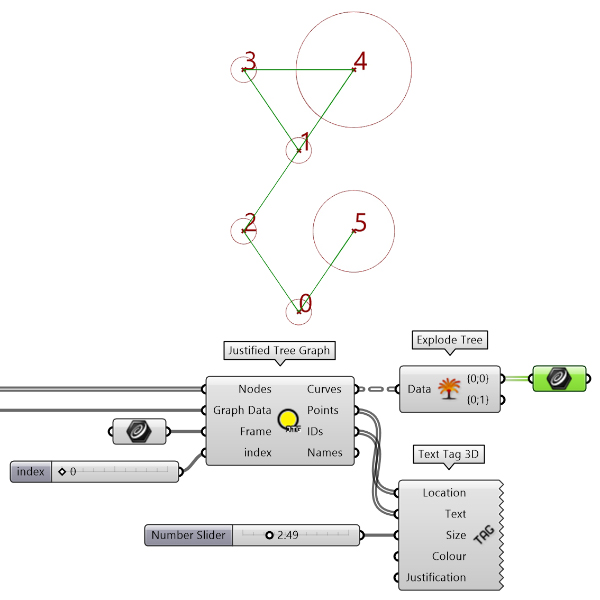
It calculates Space Syntax metrics fast and easily through points and edges. You can use these metrics in combination with the dynamic graph model for a syntactic, interactive, dynamic graph visualization.
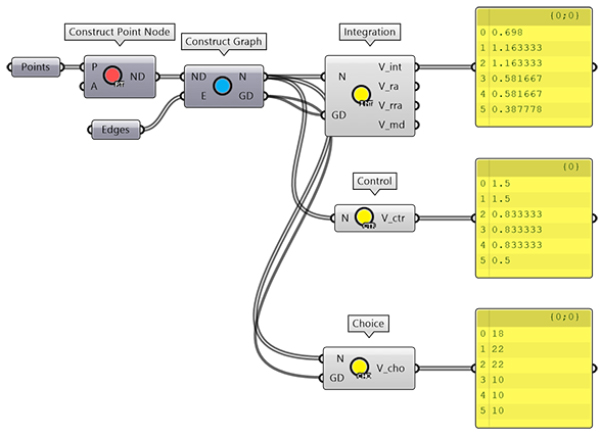
While maintaining a straightforward easy-to-use format, you can structure the output as Grasshopper data.

Finally, you can download and use this experimental add-on in Food4Rhino.
Cite this post
Related Posts
SpaceChase: A Dynamic and Interactive Tool
November 27, 2022
The SpaceChase plugin for Grasshopper focuses on initiating dynamic capabilities to Space Syntax theory by introducing the “Dynamic Canvas” model along with real-time editing capabilities in an interactive physics-based environment. Therefore, SpaceChase is a software development project for “Mekan Dizimi Tasarım Uygulaması” (no:119M082) under the ARDEB 1001 program of TUBITAK (The Scientific and Technological Research Council of Turkey). Architectural design, as a cognitive activity, has always been fed by architectural knowledge based on practice and theory, and it has been questioned how creative…
Isovist Component
May 26, 2012
Yesterday, Kağan asked me about the isovist component in Grasshopper and how it works. In fact, it is a long story, I said because once upon a time, I was curious about Space Syntax theory as my old friend Ela Çil introduced it. So, here is an original definition of Michael Benedikt: “The environment is defined as a collection of visible actual surfaces in space. An isovist is the set of all points visible from a given vantage point in…
Perseverance
October 8, 2026
While digging through my trash archives, I found this video from three years ago. Instead of exploring things with Grasshopper, I jumped into a bit of naive digital art. The Fibonacci Sphere algorithm was very popular in those days. I used the SubD components, which were new at the time. It was around the same period as the one right over there. I tried to make something scary again, but to be honest, there is also quite a depressive mood…
Gaussian Curvature
September 23, 2026
The development of geometry began by measuring the world as discrete objects. Moving beyond measuring nature, it evolved into reasoning, calculation, and mathematics. Platonic solids were one of the most elegant and beautiful ideas reached by geometry. Pondering why there are only five of them was a tribute to collective human intelligence. Earlier in this blog, we modeled polyhedra, like the Platonic solids, using geometric construction methods. This process was like solving a puzzle. To construct a point whose distances…
Syntax, Meaning, and Wasp
August 24, 2026
The question of how form emerges in architecture has always been one of the most fundamental debate topics of computational design. When I was a graduate student, we used to examine how abstract language structures made of words and rules turned into spatial and geometric systems. In this post, starting from the reflection of linguistic theories on architecture, we will talk about the logic of discrete aggregation that we study in the first year Design Computing courses. At the same…