
Complex Numbers
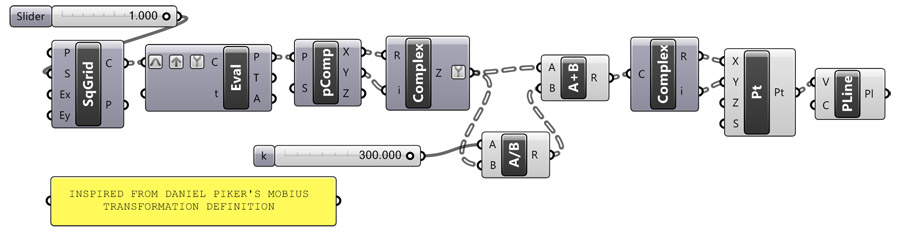
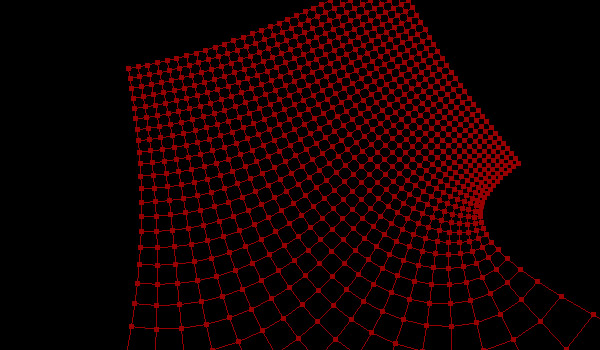
Studying circle packing led me back to my high school days. First, I’ve tried to write a vb.net component so that I would say Grasshopper to place circles and check lots of things iterating again and again. Then I felt that this was not my real interest in circle packing. After finding an old post by Daniel Piker, I’m truly enlightened about an old topic of our high school education: The complex numbers! Then I found this link, explaining the short history and meaning of complex numbers for geometry. My first try was the T(z) = z+k/z transformation of a simple square grid. This transformation is said to be studied for the aerodynamics of airfoils.
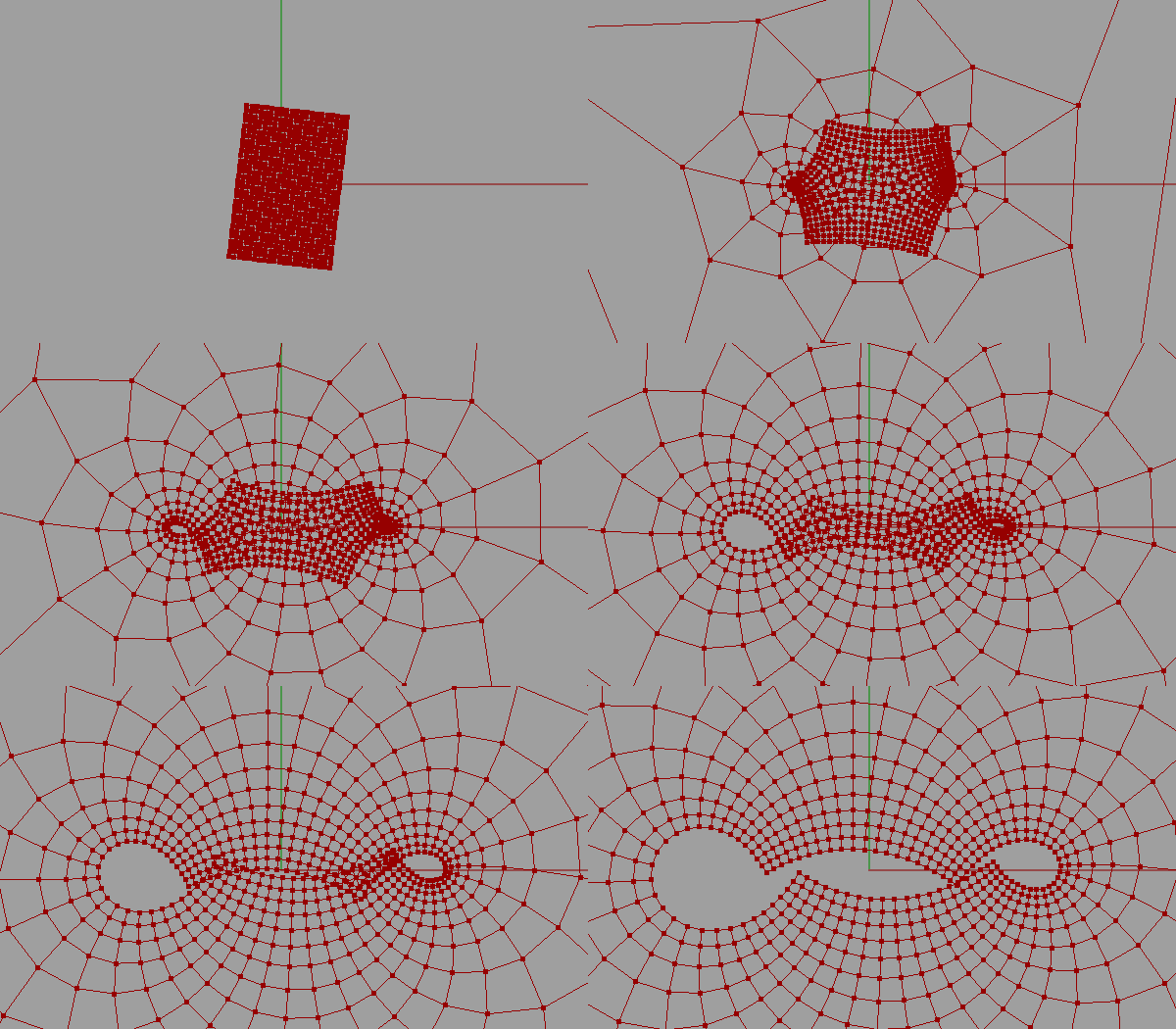
In this animation, I’m playing with the real number k and the initial square grid, and applying an equation to the complex number generated from x and y coordinates, then re-construct the square grid back again. Such transformations are called holomorphic transformations. From now on, complex number components are my friends. Things are becoming much easier with them.
Cite this post
Related Posts
Mandelbrot Set
October 10, 2012
Today’s fractal is the famous Mandelbrot Set. The Mandelbrot set is a well-known and complex mathematical set often associated with fractals and chaos theory. Named after the mathematician Benoît B. Mandelbrot, it’s a set of complex numbers defined by a simple iterative process. The Mandelbrot set is an intricate and self-similar boundary, which reveals increasingly complex patterns at different magnifications. On the other hand, I heard the term “The fingerprint of God” in some sources resembling its aesthetic and philosophical…
Julia Set
October 10, 2012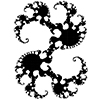
Today’s fractal is the Julia Set, the amazing simplicity of chaos. There are lots of applets and articles on the internet about this fractal. You can generate this with the iteration of a basic function many times and placing points on the complex plane. I developed a Grasshopper implementation in 2012. Also, this was my first study on complex numbers. At each iteration, the detail level increases. I utilized a common brute-force approach, distributing a grid of points, converting them…
Slope Map on Terrains
August 18, 2026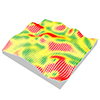
I previously shared the Grasshopper definition for terrain generation that we used in last year’s Basic Design studio. One of the goals of this project was to take the first step toward developing students’ skills in understanding, processing, and utilizing terrain data as a design input. To support this objective, we provided them with small supplementary tools. One of these tools was the slope map. As you can see, this is quite a simple Grasshopper definition. It computes the slope…
Catenary Dome without Kangaroo
August 13, 2026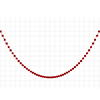
When thinking about serious and specific topics, I suddenly find myself looking back at the basics again. Catenary curves, are not the most beautiful one among those mathematical forms found in nature. However, it still tells us a lot about structures. The name apparently comes from catenaria, the Latin word for “chain”. This Grasshopper code was actually an example from our book 10 years ago (link here). It seems catenary curves could potentially be used in a type of dome…
Terrain Generator
August 13, 2026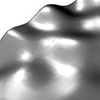
Last year, for the midterm assignment in our first-year basic design studio, we gave our students a range of different, randomly generated contexts to work with. For this purpose, I developed a small Grasshopper tool that makes the graph of a function look as much like a terrain model as possible. This tool is not really a procedural terrain generator. I would genuinely like to build one, someday. What we have here is simply a function surface. At the inputs,…