designcoding
About Table of Contents Keywords
Support designcoding!

#tutorial

82 posts

Quick Parametric Curves

July 28, 2024

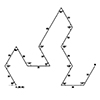
Here is the shortest possible way of generating quick parametric curves in Rhino Python. So, you may change the f, g, and h functions to test any function curve. In this Python code, the list comprehension [(f(t), g(t), h(t)) for t in [t0 + i*dt for i in range(int((t1-t0)/dt)+1)]] works by first generating a list of t values from t0 to t1 with an increment of dt using the inner comprehension. The outer comprehension then iterates over these t values,…

Modeling a Rhombicosidodecahedron

July 17, 2024

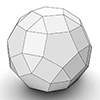
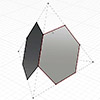
Modeling a rhombicosidodecahedron requires exploding and extending the faces of a dodecahedron and an icosahedron of the same edge length. We begin with both polyhedra centered at the same point. Then, we explode the faces of the dodecahedron and icosahedron outward from the center. We extend their planes while maintaining their orientation and shape. As these faces extend, they intersect and form new polygonal regions. Triangular and pentagonal faces emerge naturally from the extended faces of the dodecahedron and icosahedron,…

Quad Tiling on Double Curvature

April 3, 2024

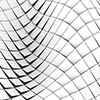
It is not possible to cover a double curvature surface with planar quads. Here is one method that overcomes quad tiling on double curvature by pulling one vertex of the quads to the plane defined by the other three. This method was used in architecture on several occasions such as the exterior facade of The Yas Hotel, designed by Asymptote Architecture in 2009. The same approach is also evident in the roof design covering the central courtyard of the Smithsonian…

Modeling the Gyroid Solid

March 30, 2024

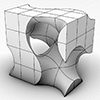
Gyroid is a popular triply-periodic minimal surface. Although it is a mathematical entity, designers and architects like its approximations very much. We used an interpretation of Gyroid in the rammed-earth structure: “Common-action Wall” in 2017. In that project, we utilized its spatial quality of dividing the space into two intertwining and symmetrical volumes. By making one of these volumes solid, I left the other void. So, in this tutorial, I am going to explain modeling the Gyroid Solid by utilizing…

Data Domains in Grasshopper

March 24, 2024

In this short tutorial, I am showing the essentials of data domains in Grasshopper. A domain is a data type in Grasshopper that represents a portion of the 1d or 2d number space. This requires a starting and ending point in those spaces. In 1d, these points are two numbers. Then, the domain represents all the numbers between them. In 2d, a data domain is represented by two coordinates (u, v). This presentation illustrates this concept with the area defined…

Curvature Approximation by Drawing

March 14, 2024

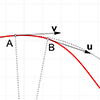
Curvature can be roughly described as how much a curve is “turning” at point a P. We place two “very” close tangents and measure the difference between them. The closer these tangents are, the more precise our approximation would be. An osculating circle is a tangent circle that has the same curvature as the curve at point P. The larger the circle, the more “flat” the curve is. An infinitely large osculating circle means the curve is linear at point…

Modeling and Unrolling Truncated Tetrahedron

March 10, 2024

Truncation refers to the process of shortening something by removing parts. You can apply truncation to numbers, text, or data in various contexts. A truncated polyhedron is a geometric solid formed by truncating the vertices of a regular polyhedron. Truncation involves cutting off the corners or vertices of the polyhedron in such a way that the original faces become polygons with new edges. This process creates new faces at the truncated vertices. It often results in a shape that is…

Coding the Dodecahedron

March 7, 2024

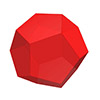
Here is a method for coding the dodecahedron and all its irregular variants in Grasshopper as quickly as possible. I utilized the golden ratio rectangles, usually used to construct the sister polyhedron, the icosahedron. However, the magic component of the Grasshopper, the Faceted Dome rescued me again to generate the dual of it, the dodecahedron. This is a special platonic solid, which has 12 regular pentagonal faces. There are several techniques that I generally prefer to use in Grasshopper. You…

Deformation of Islamic Patterns

March 2, 2024

This is the new version of my previous study on the deformation of Islamic Patterns. I love the purity and simplicity of the geometric construction processes of these patterns. It is possible to observe them in many places in many different forms. By continuing this work, I aimed to highlight the pattern deformations that map out all the variation possibilities of these patterns. Unlike previous versions, this time I aimed to achieve results ready for laser-cutting production. As you will…

Euclidean Construction of Rhombitrihexagonal Tiling

March 1, 2024

The rhombitrihexagonal tiling is one of the semi-regular tessellations. It is composed of regular hexagons, squares, and triangles. It is a periodic tessellation since you can copy the fundamental unit and move it across the plane to generate the tiling. I use this quality of the tiling to draw and expand it in Rhinoceros software. This is a basic drawing exercise. At the same time, it is a nice exercise for the mind and sometimes for the soul. There are…

« 1 2 3 4 5 6 7 8 9 »
  • Chapters

    • Algorithms
    • Discourses
    • Fabrications
    • Studios
  • Explore

    • #archimedean-solid
    • #design-competition
    • #processing
    • #eps-foam
    • #nesting
    • #puzzle
    • #revit
    • #3d-printing
    • #ice-ray
    • #exhibition
    • #space-syntax
    • #sphere
    • #paper
    • #galapagos
    • #macro
    • #optimization
    • #circle
    • #stone
    • #islamic-pattern
    • #truchet
    • All Keywords
    • Table of Contents
    • Monthly Archive
  • Search

  • Patreon

    Support designcoding!

    Enjoying designcoding? Support its future with a small donation on Patreon. Thank you!


    copyright 2026 designcoding.net | about | privacy policy | end user license agreement