
Modeling a Rhombicosidodecahedron
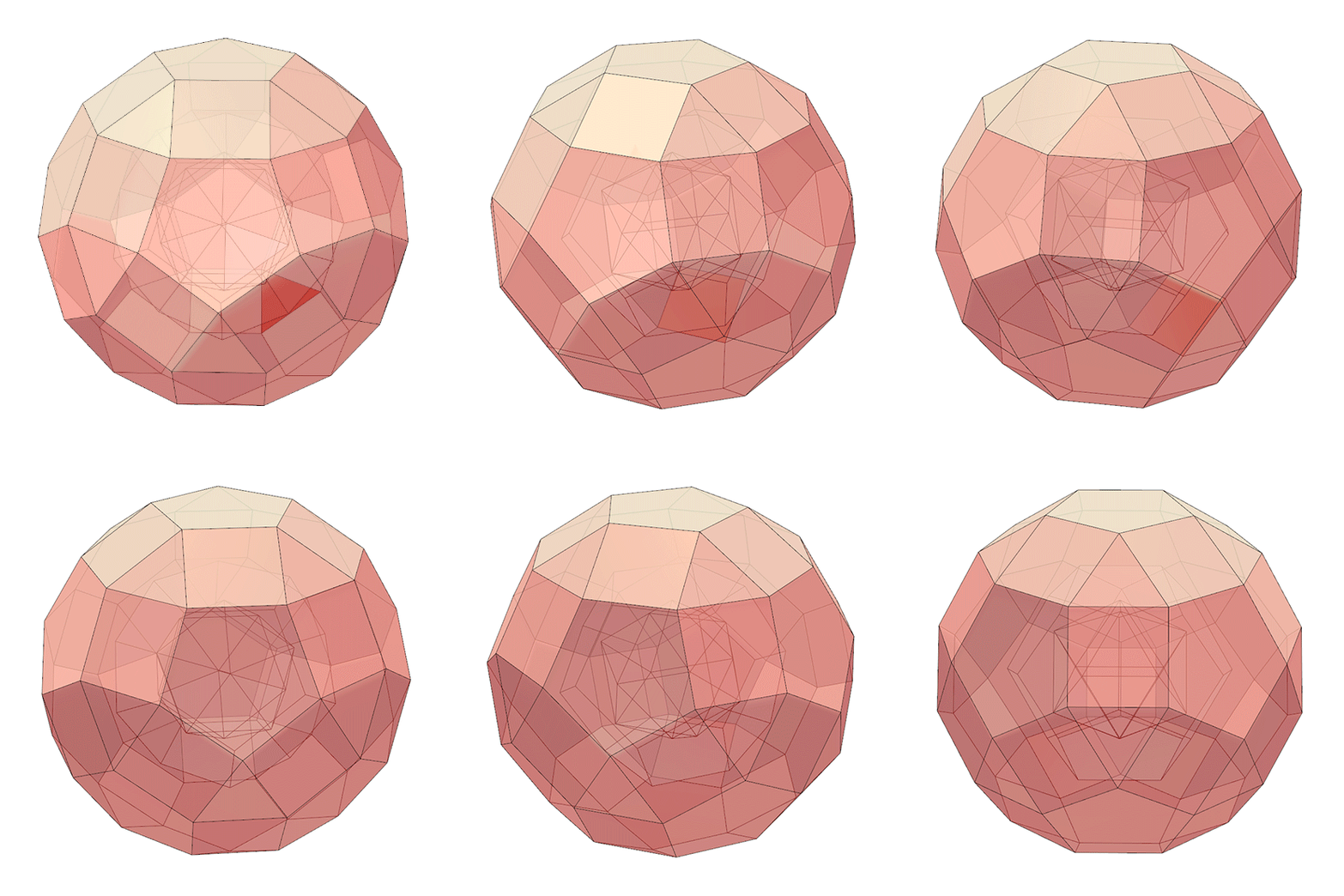
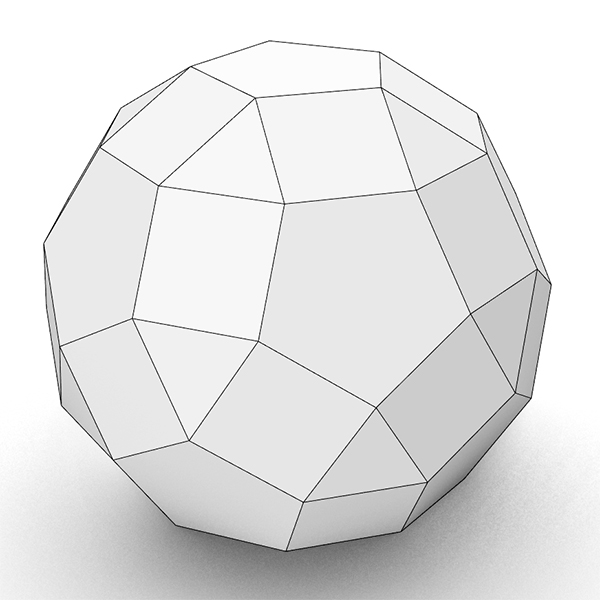
Modeling a rhombicosidodecahedron requires exploding and extending the faces of a dodecahedron and an icosahedron of the same edge length. We begin with both polyhedra centered at the same point. Then, we explode the faces of the dodecahedron and icosahedron outward from the center. We extend their planes while maintaining their orientation and shape. As these faces extend, they intersect and form new polygonal regions. Triangular and pentagonal faces emerge naturally from the extended faces of the dodecahedron and icosahedron, respectively. The extended faces from the dodecahedron form pentagons, while those from the icosahedron form triangles. Once these faces are in place, fill the remaining gaps with square faces. This will create a polyhedron with 20 triangular faces, 30 square faces, and 12 pentagonal faces.
In chemistry and molecular biology, the geometry of the rhombicosidodecahedron can inspire the design of molecular structures and nanomaterials, including certain types of fullerene molecules. Additionally, computer graphics and 3D modeling are often used to create structurally sound models.
Cite this post
Related Posts
Modeling Rhombicosidodecahedron
December 15, 2024
The rhombicosidodecahedron, an Archimedean solid, is one of the 13 convex polyhedra made up of regular polygons. While all its faces are congruent, they consist of various types of regular polygons. I previously explored this fascinating polyhedron and am revisiting it now as part of the Architectural Geometry course. In this short tutorial video, I demonstrate the modeling of a rhombicosidodecahedron. Despite its lengthy and unusual name, this polyhedron is truly a remarkable and beautiful structure. I hope that this…
Icosidodecahedron
December 22, 2011
Icosidodecahedron is an Archimedian Solid, a thing in between the Platonic Solids of Icosahedron (d20) and Dodecahedron (d12). It is a rectified version of an Icosahedron, constructed by dividing every edge into two equal segments and joining these segments to create a composition of equilateral pentagons and triangles. Archimedian Solids consist of at least two equilateral polygons, whereas Platonic Solids are constructed by only one. We’ll deduce an Icosidodecahedron from Icosahedron below; First, you should create an Icosahedron, the Platonic…
Modeling Excavated Dodecahedron
December 15, 2024
In geometry, the excavated dodecahedron is a star polyhedron that looks like a dodecahedron with concave pentagonal pyramids in place of its faces. In this short tutorial video, I am modeling an excavated dodecahedron in the Rhinoceros software. I use basic drawing and modeling commands. I aim to introduce this skill to beginner-level architects and designers. As the name suggests, this process includes the construction of the dodecahedron first. Then, the pentagonal faces of this polyhedron were “excavated” to the…
Modeling and Unrolling Dodecahedron
December 12, 2024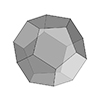
A dodecahedron is a three-dimensional polyhedron with twelve flat, regular pentagonal faces, twenty vertices, and thirty edges. It is one of the Platonic solids and is highly symmetrical, with each face being a regular pentagon. The dodecahedron’s shape is unique among the Platonic solids because its faces are polygons with five sides, unlike the others which have triangular faces. Due to its symmetry, the dodecahedron has been used in various applications, including as a model in geometry and in certain…
Modeling a Dodecahedron
February 14, 2024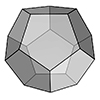
This is a 3d modeling tutorial for the platonic solid of dodecahedron. Modeling a dodecahedron is a good exercise for the basic transformation commands such as Rotate3D in Rhinoceros. You will see that it is possible to calculate the rotation angle by using sphere intersections. I learned this elegant method while teaching Architectural Geometry classes 12 years ago. It is based on the fact that, given a rotation axis and the rotation point, you can draw the path traced by…