
Rhinoceros Layout Tutorial
In Rhino, layouts are used to prepare drawings for printing or presentation. They provide a way to organize and display 2D views of your 3D model, such as top, front, side, and perspective views, in a way suitable for producing printed or published documents. In this short tutorial video, I show the basic usage of the Rhinoceros layout system. So, this Rhinoceros Layout Tutorial video is for beginner-level CAD users. Therefore, you can use it to create PDF posters and pages quickly and precisely inside the Rhinoceros. This would eliminate the need for another software to do that job.
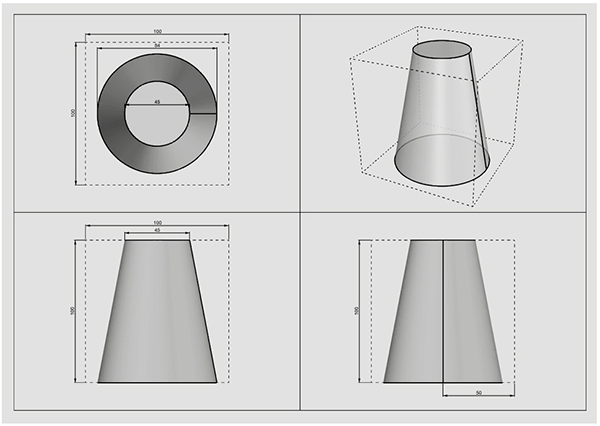
I have been conducting a series of in-class exercises in the freshmen year Architectural Geometry course, focusing on Euclidean constructions, basic drawing, and transformation commands. In addition to these basics, I study introductory fractals, regular and semi-regular tessellations, patterns, modeling, and unrolling polyhedra using Rhinoceros software. Junior architects, interior designers, industrial designers, and enthusiasts from other disciplines can benefit from these concise drawing exercises. I am planning to publish this kind of basic exercise every week on my blog and other platforms. So, today’s exercise is the Rhinoceros layout tutorial.
The software used in this course is Rhinoceros 3d (www.rhino3d.com). However, if you want to find out more and see the whole list of this video series, you can check my YouTube channel at www.youtube.com/@designcodingnet. The music of this video is ‘What We Don’t Say’ by Scott Buckley (CC-BY 4.0). www.scottbuckley.com.au
Cite this post
Related Posts
Rhino Print Dialog
November 2, 2013
Here is a simple description of Rhinoceros’ Printing dialog. It is the same with version 4.0, nothing changed in layout and printing dialogs in 5.0. Significantly our Architectural Geometry classes should benefit from this explanation. Most of these options should be tested with a plotter (e.g. pencil widths) before final print-outs. Also, you may try creating a PDF file of your homework from this dialog.
Scripting Tab in Rhino 5
December 11, 2012
Last year, I posted a way to create a Grasshopper command button in Rhino 4 (here). As the scripting possibilities increase in Rhino 5, the new tab feature can be used to put them together. I’ve made 4 of the most used platforms in a tab named “Scripting”. Here is how I did it; Use right-click on the empty area to open the above menu and select “new tab” to create an empty tab, naming it “Scripting. Right-click on the…
Some Rhino Tips
February 15, 2012
Here are three technical tips, that might help you model in Rhinoceros faster. In most cases, you’ll find CTRL+F1,F2,F3 and F4 very helpful in modeling and transforming objects in digital space. These key combinations will focus you on Top, Front, Left and Perspective views (maximized) respectively. Also, when you try to express your design process (especially supporting geometries) using different linetypes, it’s possible that you’ll never like those preset linetypes. By choosing Tools / Options, you’ll have the opportunity to change and add new…
Modular Roof Project
January 25, 2012
This was a design competition of a precast concrete roof system. My design proposal was a modular and variable structure for İstanbul’s old bus station, converted to art galleries. However, this project was developed purely by hand-sketches, I’m planning to create an envelope of alternatives by creating a parametric model. Each module is proposed to be converted differently in order to meet various functions such as single or double module galleries, shopping and restaurant, and a theater also. The varying…
Modeling Waves Relief
December 16, 2024
Relief in the context of art and sculpture refers to a technique where a three-dimensional form is created on a flat surface. The object or figure “protrudes” from the background, creating depth and texture. In this short tutorial video, I am modeling waves relief using the basic drawing and modeling commands of the Rhinoceros software. Here, I use the point surface command. Because, in Rhinoceros, generally we describe the parametric surfaces as four-sided objects. So, this exercise is a basic…