
Digital Fabrication Course: Day 1
In this semester, I started a new elective course at İstanbul Bilgi University Faculty of Architecture. Second, third and fourth-year architecture, interior design, and industrial design students attend the course titled “Digital Fabrication”. I am very excited to study the basics of robotic fabrication together with the students. I’ll try to report the content of the lectures and the robot exercises on designcoding.net. Below is the general brief of the course (not specific to any fabrication machine, however, this semester is about the six-axis robot.
This course will guide undergraduate students of architecture and interior design through digital fabrication technology. It is offered in several chapters which introduce students to necessary knowledge and hands-on experience of digital fabrication. After several lectures on mathematics, programming, and basic operational skills of computer-aided manufacturing (CAM) machinery, students are expected to propose a term project. The term project includes a wide range of topics, including; reducing waste materials and fabrication costs, issues on variation and similarity, precision and accuracy, geometry and materialization, tutorials and education, programming and add-ons. Students are expected to discuss, develop and present a unique approach to the use of new digital fabrication methods for a chosen design challenge. This is expected to widen their visions and help them define their own attitudes towards digital fabrication technologies.
On day one; we had a short presentation about the robotic arm, its specifications, and safety rules.
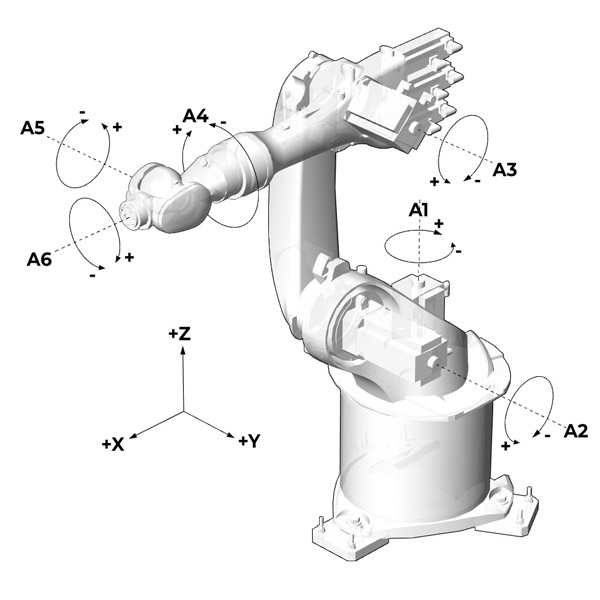
We also had a quick exercise. This exercise was intended to get familiar with the handling and usage of the smartPAD. We experimented with the jogging of all six axes, understanding positive and negative rotations. Then, tried cartesian jogging, understanding the X, Y, and Z axes of positioning the TCP, and A, B, C rotations around those axes. After getting comfortable with the above, we used a gripper tool to pick and place several wooden blocks on top of each other;
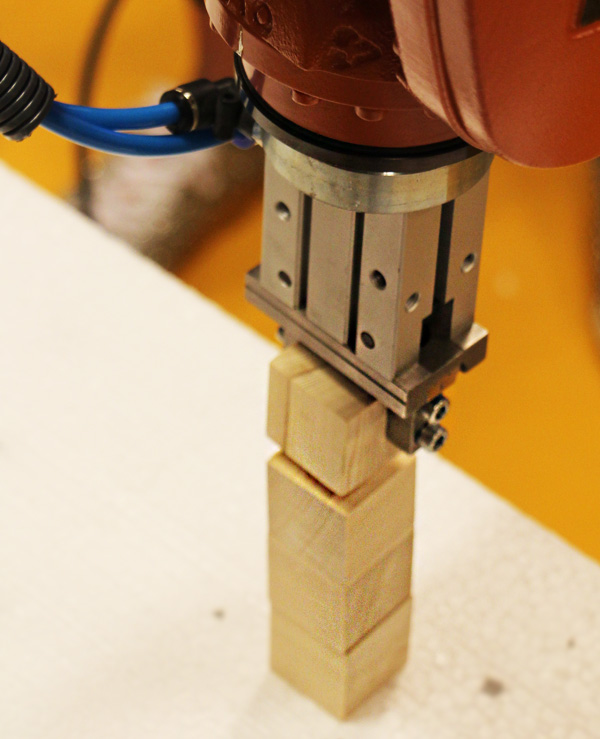
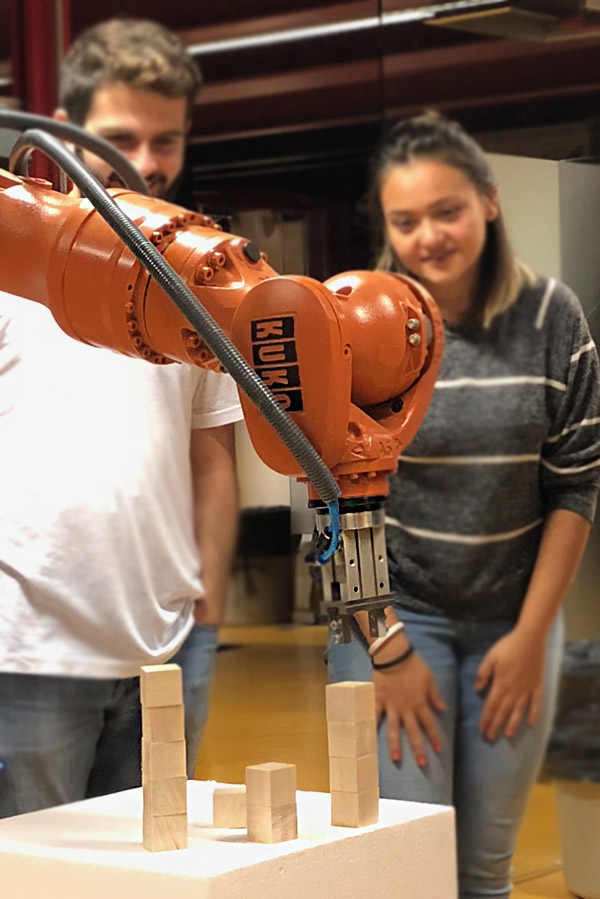
Photos: Meryem N. Yabanigül
Students were pretty excited to control the “monstrous-looking” machine on day 1.
Cite this post
Related Posts
Robotic Fabrication Project KUKABAE
March 6, 2019
I will try to explain the student project called KUKABAE that was developed in my Robotic Fabrication elective course in 2018. This was a very interesting project. Initially, the students were doing the design to attach an ordinary pen holder to the robot. but then the project changed by chance. they decided to replace a pen holder with a ceramic knife. As seen in the video and pictures, the relationship between the material and the instrument became more complicated and…
Robotic Chopstick Digger Exercise
November 5, 2018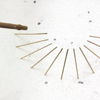
Today, we tried to understand one of the ways of generating multiple planes in Grasshopper. This is an important step in utilizing the robot program efficiently. Instead of manually jogging the robot, we designed the path that the robot will dig lots of chopsticks. In the “Robotic Chopstick Digger Exercise”, every student designed their own paths and decided the height, orientation, and number of sticks to be dug on an EPS block. I provided the Rhino and Grasshopper files with…
Digital Fabrication Day#4: Kissing the Cube
October 25, 2018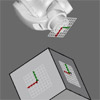
In the Digital Fabrication course, we are in the middle of a sea, full of technical details, and students need motivation. This is why I felt I should do something simple and educational but funny at the same time; a “kissing the cube” exercise. The planned exercise was about programming the robot to touch every facet of a cube without colliding with it. Of course, we couldn’t manage to kiss all the facets due to the limitation of the robot’s…
PLURA Pavilion
September 22, 2026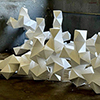
Last year, during the first stage of the Architectural Design Graduate project, our student team made a quick preparation and participated in the experimental works exhibition at the International Antalya Architecture Biennale (IABA 2025). This was a challenging yet educational process for our team. Using EPS foam and the robotic hotwire cutter (RHWC), a production run of 125 units, consisting of two modules (95 octahedra and 30 icosahedral units), was carried out. The icosahedral units also underwent an additional cutting…
Hydrophilic Structures
June 6, 2019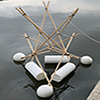
Hydrophilic Structures is the 2018-2019 Spring Semester Graduate Studio of the Architectural Design Program. The studio aims to increase the public interaction with water, while being sensitive to the ecological and historical context of the shores of İstanbul. Students will be encouraged to design sustainable, floating modules and structures, which can be integrated into semi-open architectural programmes. A full-scale prototype will be fabricated and tested at the Santral Campus coast to Haliç. The main conceptual framework of the studio consists…