
Design Mathematics Student Work: Enneper Slide
In Design Mathematics 2019 course, Berke Çelik designed the Enneper Slide in his final project. The Enneper surface is an interesting case since it is a minimal surface with potential variations for spatial implementations. Berke used Rhino Math and Grasshopper / Weaverbird to generate his design. I think the Enneper Slide, as a minimal surface, is an exciting start for a Design Mathematics student work. But as always, much more could have been studied. Unfortunately, Rhino Math is no longer working in Rhino 7. However, we re-created the tool in the upcoming years’ Design Mathematics courses.
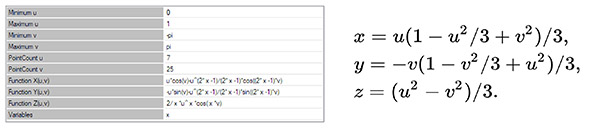
The formula he used to construct the student work: Enneper Slide. You can see the Rhino Math input domains and the three parametric functions that control x, y, and z coordinates.
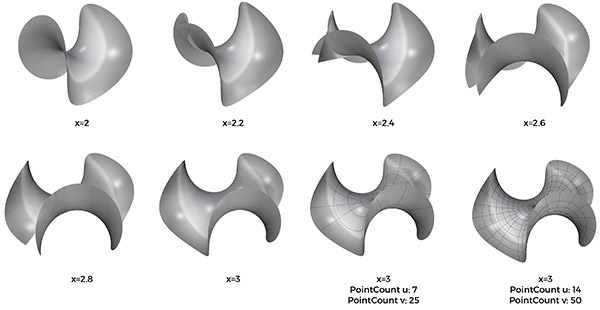
Several variations of the student work: Enneper Slide
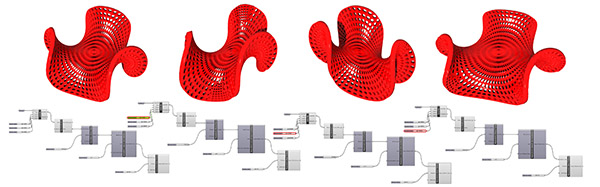
Weaverbird application to the selected surface. Is it that simple?
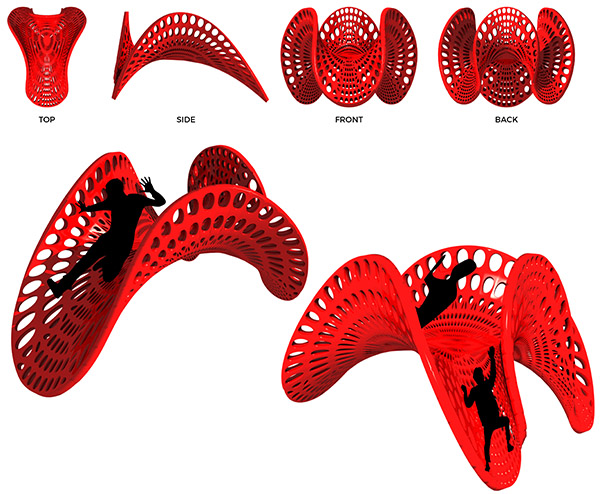
This study is interesting because of its direct implementation as a “slide”. I am not sure about the real potential of it. However, if you think about CAD in general, and all the parametric surface families, it is just one of them, chosen to be built. After this initial step, you can advance this kind of project by merging the mathematical qualities (being a minimal surface for instance) with the spatial, functional, and material qualities. Otherwise, this cannot go beyond a form-finding study. After the 2018 and 2019 experiences, I changed this elective course a lot. Now, I am studying and teaching the fundamental mathematical concepts used in CAD. This becomes an increasingly interesting field for me. I hope I can live long enough to see the end of it.
Cite this post
Related Posts
Modeling the Gyroid Solid
March 30, 2024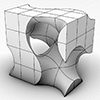
Gyroid is a popular triply-periodic minimal surface. Although it is a mathematical entity, designers and architects like its approximations very much. We used an interpretation of Gyroid in the rammed-earth structure: “Common-action Wall” in 2017. In that project, we utilized its spatial quality of dividing the space into two intertwining and symmetrical volumes. By making one of these volumes solid, I left the other void. So, in this tutorial, I am going to explain modeling the Gyroid Solid by utilizing…
Modeling The Gyroid
May 16, 2023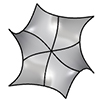
Here is the method I used for approximately modeling the Gyroid, a triply-periodic minimal surface. It is very popular in architecture because the symmetrical solids and voids it generates are interesting. I modeled this for the Common-action Wall project we exhibited together with Fulya Akipek in 2017. After several attempts to generate it in Grasshopper, I decided to model it in Rhino. There are some sources on the internet, explaining the geometric modeling process. However, none of them was giving…
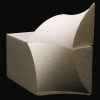
This is the new paper with Meryem Nurefşan Yabanigül, published at Automation in Construction. It is also Meryem’s master’s thesis. This study is about testing the production of curved surfaces with non-linear robotic hotwire cutting and shape memory alloys. Below is the abstract of it: Robotic arms are being used by construction firms and schools of architecture around the world in design/build research and material studies. Some of these studies utilize robotic hot wire cutting (RHC) as an efficient production…
S-ARCH Award
June 4, 2018
The “Common-Action Wall” Project of the POTplus Design Research Group, founded by Fulya Akipek and Tuğrul Yazar from BİLGİ Faculty of Architecture, got an honorable mention in the category of “Completed Projects/Small Projects” in “S.ARCH 2018 Project Award”. For detailed information about the “Common-Action Walls” Project, please click here and here Members of the Jury: Toyo Ito, Toyo Ito & Associates, Architects (Japan)Prof. Will Alsop, aLL Design (UK)Mats Ove Frosterud, TENGBOM (Sweden)Prof. Leon van Shaik, RMIT University (Australia)Viviana Muscettola, Zaha Hadid Architects (UK)Peter Exley, Architecture is Fun (USA)Jan Mattsson,…
Common-action Wall
January 9, 2018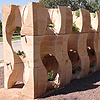
In 2017, during the 4th International Architecture Biennial of Antalya, we constructed the Common-action Wall in Karaalioğlu Park. We designed this architectural prototype as a wall that enables the growth and harvesting of edible plants for park users. To facilitate plant growth and ensure sunlight access, as well as to direct rainwater toward the plants, we conducted extensive studies on minimal surfaces. Ultimately, we found that the gyroid form met all the requirements. It proved advantageous during the production process,…