designcoding
About Table of Contents Keywords Monthly Archive
Support designcoding!

#tessellation

33 posts

Variable Voronoi Study

November 30, 2012

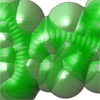
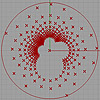
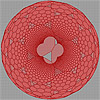
I’ve been searching for a method to study the Voronoi subdivision in order to manipulate it. There are well-known algorithms for that. But I thought it would be better if I use a projective approach just as I did in studying hyperbolic space (here). This is the metaphor of inflating balloons. However, I inflated cones instead of spheres. This way, it became possible to modify the algorithm. So I was able to develop a kind of variable Voronoi study here….

Parquet Deformation Handmade

October 31, 2012

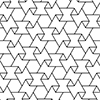
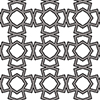
This is not to explain the method of the Parquet Deformation but to see the potential. After we’ve studied regular, semi-regular, dual, and truncated tessellations with students, the Architectural Geometry course expects them to develop a Parquet Deformation handmade such as those shown below. I call them Parquet Deformation handmade. Because they are manually designed but drawn using traditional CAD. The samples you see below are from this website. It is a good source for other topics of tessellation as well….

Cairo Pentagonal Tiling

October 22, 2012

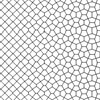
This is a late update for my 2012 study on Cairo Pentagonal Tiling (or Cairo Tessellation). Originally, it was an exercise of dual tessellations. Because this tiling is the dual of the famous semi-regular tessellation of Snub Square. After coding the Snub Square tiling, I attempted to generate the dual of it. However, that created an inefficient result. This latest version generates the original Snub Square and Cario Pentagonal Tilings. Moreover, it is possible to play with the inputs to…

Snub Square Tiling

October 22, 2012

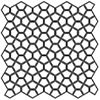
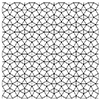
Here is the step-by-step generation of the old Snub Square Tiling. Frankly, this is the first step in the generation of Cairo Pentagonal Tiling I generated with Grasshopper earlier. Because Cairo pentagonal is the dual of a snub square. The first step was easy. Just dispatch cells of a square grid, then evaluate them according to the ratio of 0.366 approx. which is derived from the bisector of an equilateral triangle. Now, we have a snub square tiling, composed of…

Islamic Patterns of Semi-Regular Tessellations

October 22, 2012

The intricate harmony of the Islamic Patterns is amazing. The geometry of this and other Islamic pattern designs are explained in the 3rd chapter of Craig S. Kaplan’s Ph.D. dissertation. I constructed a semi-regular tessellation, particularly the 4.8 because it seems to open interesting explorations that mostly emerge from truncated squares. We know equilateral triangles and hexagons are also fundamental shapes for this task. However, the dual nature of the semi-regular tessellations makes a difference in most compositions. First, I…

Hyperbolic Tessellations Continued

July 26, 2012

We can create tessellations of outer points in a Poincare Disk, using the manual method explained in the last post (here). But repeating that compass and straightedge process is becoming a little useless after a couple of repeats. If you say “ok. I understood the concept, let’s get faster!” then we can model just the same process in Grasshopper3D to examine varying results in seconds; If we connect any grid of points into this definition, we can clearly see the similar…

Hyperbolic Projection of a Semi-regular Tessellation

July 7, 2012

Truncated hexagonal tessellation (or named 3-12-12) is represented in hyperbolic space (as far as I understood it). The idea is simple if you don’t mix it with complex equations. Below is the 2-dimensional representation of hyperbolic projection. Paper space is defined by the thick line there. Projection is based on a two-sheet hyperboloid surface. Euclidean version of this tessellation is described here.

Semi-regular Tessellations

May 24, 2012

Creating and handling new types of grid configurations might be an important topic, as Grasshopper is not supporting them natively (yet). I tried to create some semi-regular tessellations based on regular grids. It is actually truncated versions of regular grids, but it slowly becomes interesting as I realized that I may further truncate emerging grids to create Level 2 and Level 3 grids with more complex tessellations. Here are two examples of Level 1, truncating regular tessellations of squares and…

Eschers Tessellations

March 29, 2012

After Puzzling, I tried to establish more of Escher’s basic grid transformations using Grasshopper’s native components. This definition simulates Escher’s transformation of four-cornered grids. The postulate is based on the fact that every quadrilateral (or triangular) planar shape can create regular tessellations without gaps or overlaps. In the traditional method, this tessellation is achieved by rotating the shape 180 degrees and copying afterward. However, in Grasshopper we simply define the fifth point for each shape and divide subsurfaces into four…

Puzzling

March 21, 2012

Nowadays, I found myself back into traditional hand sketching. Several failed attempts on Grasshopper led me back there. NURBS (and Grasshopper) somehow limits our conception of surfaces to four-cornered (or two-directional) manifolds. Although it sounds like limiting our designs, having four-cornered component spaces has still lots of experimental fields for designers. Escher is a cult person, who transforms the euclidean coordinate system to meet his design intentions. There are lots of interesting research about him, and he shows us how…

« 1 2 3 4 »
  • Chapters

    • Algorithms
    • Discourses
    • Fabrications
    • Studios
  • Explore

    • All Keywords
    • Table of Contents
    • Monthly Archive
    • #tensegrity
    • #attractor
    • #cnc-milling
    • #stone
    • #snub-square
    • #simulation
    • #quad
    • #robot
    • #vector-field
    • #solar-analysis
    • #3d-max
    • #brick
    • #hoopsnake
    • #sandblasting
    • #hyperbolic-paraboloid
    • #unrolling
    • #dual
    • #processing
    • #muqarnas
    • #arduino
  • Search

  • Support designcoding!

  • Enjoying designcoding? Support me on Patreon to keep it growing. Thank you!

  • copyright 2026 designcoding.net | about | privacy policy | end user license agreement