
Chinese Ice-ray Lattices Revisited
One of the cult texts in Shape Grammars theory is Stiny‘s Chinese Ice-ray Lattices Grammars. Although it is full of technical terms, it represents an analysis of a working algorithm. We can directly transfer that from the behavior of an artist.
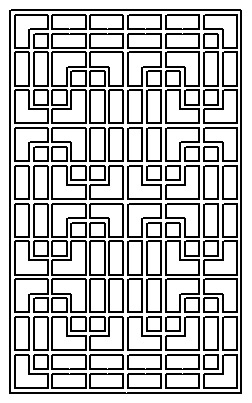
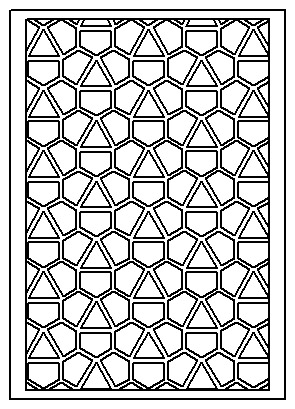
One can imagine a Chinese artisan, summoned to a building site. He brings tools and implements and a collection of finely finished sticks. Then, he begins his design by selecting a stick of the appropriate length and carefully attaching it between two edges of the existing rectangular frame, thus forming two quadrilateral regions (shape rule 3). He continues his work by subdividing one of these areas into a triangle and a pentagon (shape rule 2).
He further divides the triangle into a triangle and a quadrilateral (shape rule I). Then, he divides the pentagon into a quadrilateral and a pentagon (shape rule 4). He made each subdivision in the same way. Attach an appropriately sized stick between two edges of a previously constructed triangle or quadrilateral or pentagon so that it does not cross previously inserted pieces. Each stage of the construction is stable; each stage follows the same rules. Indeed, the steps in the ice-ray lattice generation we give in Figure 5 could well comprise the frames in a motion picture of the artisan creating his design!
Stiny, G., (1977), “Ice-ray: a note on the generation of Chinese lattice designs”
Here, I introduced a Grasshopper implementation of the subdivision algorithm of Chinese Ice-ray Lattices. Here is the Turkish translation of the above paper [PDF File].
Cite this post
Related Posts
Ice-Ray Lattices Revisited
April 9, 2015
Further studying iteration in Grasshopper, this time, inspired by George Stiny’s “Chinese Ice-Ray Lattice” subdivisions with Aneome, instead of the Hoopsnake add-on I tried in the previous work. As you know, loops add various ways of usage to Grasshopper. In future versions, loops may cease to be just an add-on and become native components of Grasshopper. Until then, loop plugins like Anemone take on this task. In the example here, we create an application by throwing random lines to divide…
Syntax, Meaning, and Wasp
August 24, 2026
The question of how form emerges in architecture has always been one of the most fundamental debate topics of computational design. When I was a graduate student, we used to examine how abstract language structures made of words and rules turned into spatial and geometric systems. In this post, starting from the reflection of linguistic theories on architecture, we will talk about the logic of discrete aggregation that we study in the first year Design Computing courses. At the same…
PatGen: Islamic Pattern Generator
February 27, 2013
It was the 2008, eCAADe Presentation at Antwerp together with Birgül Çolakoğlu and Serkan Uysal. This paper presents a student work developed in the Introduction to Computational Design graduate course titled “Designing the Design” at Yildiz Technical University. The course focuses on the use of algorithms as design tools, rather than coding experiments. The course runs parallel to the shape grammar course. There, we study the basic concepts of computation through visual design exercises. So, the shape grammar course teaches…
QuickShaper
April 5, 2012
QuickShaper (QS) an experimental computer utility for Shape Grammars. It aims to assist designers and students in creating and exploring rule-based designs. QS is first presented and published with Birgül Çolakoğlu at the 25th eCAADe Conference held at Frankfurt / Germany in September 29th, 2007. QS is a scripted utility, written in MaxScript, developed within Autodesk’s 3D Studio MAX version 9. It is not tested on earlier versions. QS works well with Max Design 2011 after modified 1.80 version. This…
Ice-ray Lattices
February 5, 2012
The design of Chinese window lattices named “ice-ray” is one of the classic studies of Shape Grammars. It is an old and good example of algorithmic design. George Stiny explained their geometric construction based on the parametric Shape Grammars approach. He explained shape rules and the abstract machine that produces the subdivisions. I was especially interested in Shape Grammars when I was a graduate student. I even made a prototype tool for Shape Grammars in MaxScript. Here is another post…