
Precast Parapets in Grasshopper
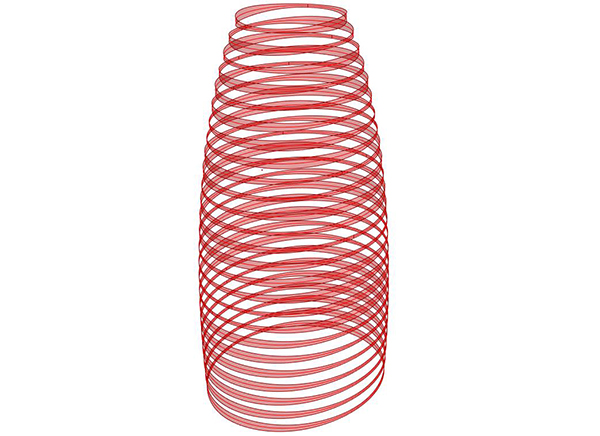
I found the Grasshopper code I wrote in 2014 while helping a friend with a construction detail project. These structures were cigar-shaped and featured quite challenging interior layouts. A significant part of the detail design phase was the facade study. Such a waveform was requested for the balcony railings, wrapping around all the building’s facades. As you can guess, Grasshopper was a tailor-made tool for this exact job. I revised the code in 2020. Unfortunately, I couldn’t find the version that incorporated the parapet thicknesses.
If Parametric Design was Honest
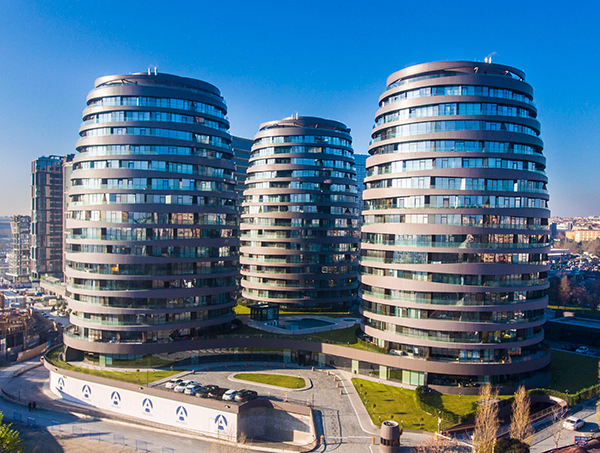
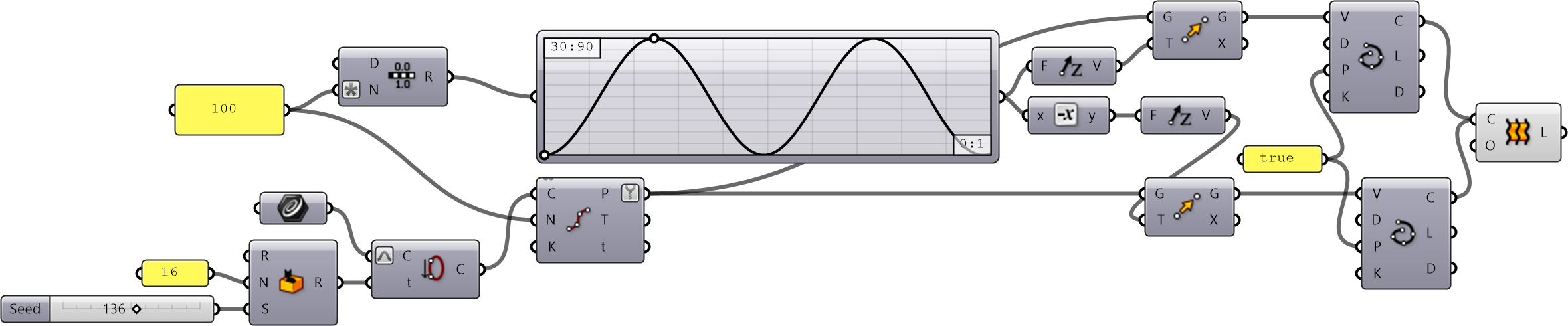
This code is actually very simple yet useful. Not only does it visualize the design, but it also generates a list of the exact length for each individual railing element. Doing such automation with parametric modeling tools was quite trendy back then. Looking back now, it brings back memories of those times and the effort we put in. Two years ago, I was near these buildings and caught glimpses of them from time to time. Of course, computational design and parametric modeling carry responsibilities beyond automation and profit-making. In this project, however, these interfaces were used solely to serve the architect’s aesthetic concerns and realize a geometric design. As one of my friends says, “Aesthetics is a function.” Sometimes I think to myself: we need to be honest and call things what they are, without deceiving one another with bold words like “sustainability” with an empty background. Not every single design has to save the planet and humanity, but it can be honest about what it can achieve. Frankly, sometimes we just have to save the day, don’t we?
Cite this post
Related Posts
Louvered Structures Update
November 13, 2026
I see that nowadays everything is accelerating at a terrifying pace with AI. Acting like a complete dinosaur in yesterday’s class, I looked back and talked about this facade design code I wrote in 2015. One of its early versions was a classic wavy facade using an aluminum frame and membrane. 10–15 years ago, these were very trendy. They were designed for use on a factory facade. Right now, my goal is to use this to explain some fundamental concepts…
Wave Generator
April 17, 2024
Here is a wave generator code I developed using Grasshopper and Python. While searching for a solution to the realistic water simulations, I came up with the Gerstner Waves. I tried to implement it. However, I came up with this final result, which is not a Gerstner Wave generator, but a much simpler one. It combines many user-fed wave components and calculates the resulting single wave. I played with this code for hours with different components. So, it is worth…
Rhombus Facade
June 4, 2023
This is the continuation of a very old parametric model of a building facade, presented here. I will introduce the basic Grasshopper definitions of several alternative designs. The first one is the rhombus facade. The first part of the algorithm deals with the necessary data collection. We reference a polyline from the Rhino model as the path that the facade will follow. After that, we create vertical lines around the path. Then, we shatter these lines by using a Graph…
Point Waves
May 29, 2023
Here is another basic exercise in Grasshopper. This exercise “Point Waves” creates wave-like deformations on the grids of points. The major function of the definition is to calculate the distances from every point of a grid to an attractor point, with the help of Distance (Dist). Then it sorts them from the smallest to the largest (= closest to farthest) with the Sort List (Sort) component. This component takes and matches two lists of the same size, called key (K)…
Facade Studies
April 11, 2015
Some facade studies as early sketches of an architectural project; all of them are utilizing a similar Grasshopper approach. My favorite “Graph Mapper” generates the overall gridal deformation, then some of them are drawing geometry for membranes, while others are generated to be realized from sheet metal. Hopefully, one or two of these could be further studied: “Below, I am sharing my favorite among these codes. I had to pull off some geometric acrobatics to affect all four facades of…