
Campanus Sphere
I want to introduce a concept I came across the other day, one I had never heard of before, along with a few fantastic websites. The Campanus Sphere is essentially a rather crude spherical representation, the kind I’m used to seeing in (very old) computer games, and it also makes a nice nod to 80s disco culture. I also recall that in many older CAD software packages, spheres and sphere-related Mesh objects were represented as polyhedra using this method. However, I didn’t know it had a geometric name and a quite dedicated fan base. I got the historical information about this solid from this wonderful website. According to it:
This kind of polyhedra that are inscribed in a sphere was well know by Euclid. In proposition 17 of book XII Euclid shows how to construct a polyhedron sandwiched between two concentric spheres. During the Middle Ages, Campanus of Novara (1220-1296) wrote a very popular version of Euclid’s Elements. Campanus used this construction to describe a 72-faced polyhedron. This polyhedron was very popular during the Renaissance and was known as Campanus´ sphere. Leonardo da Vinci draw this polyhedron to Luca Pacioli’s book ‘De Divina Proportione’.
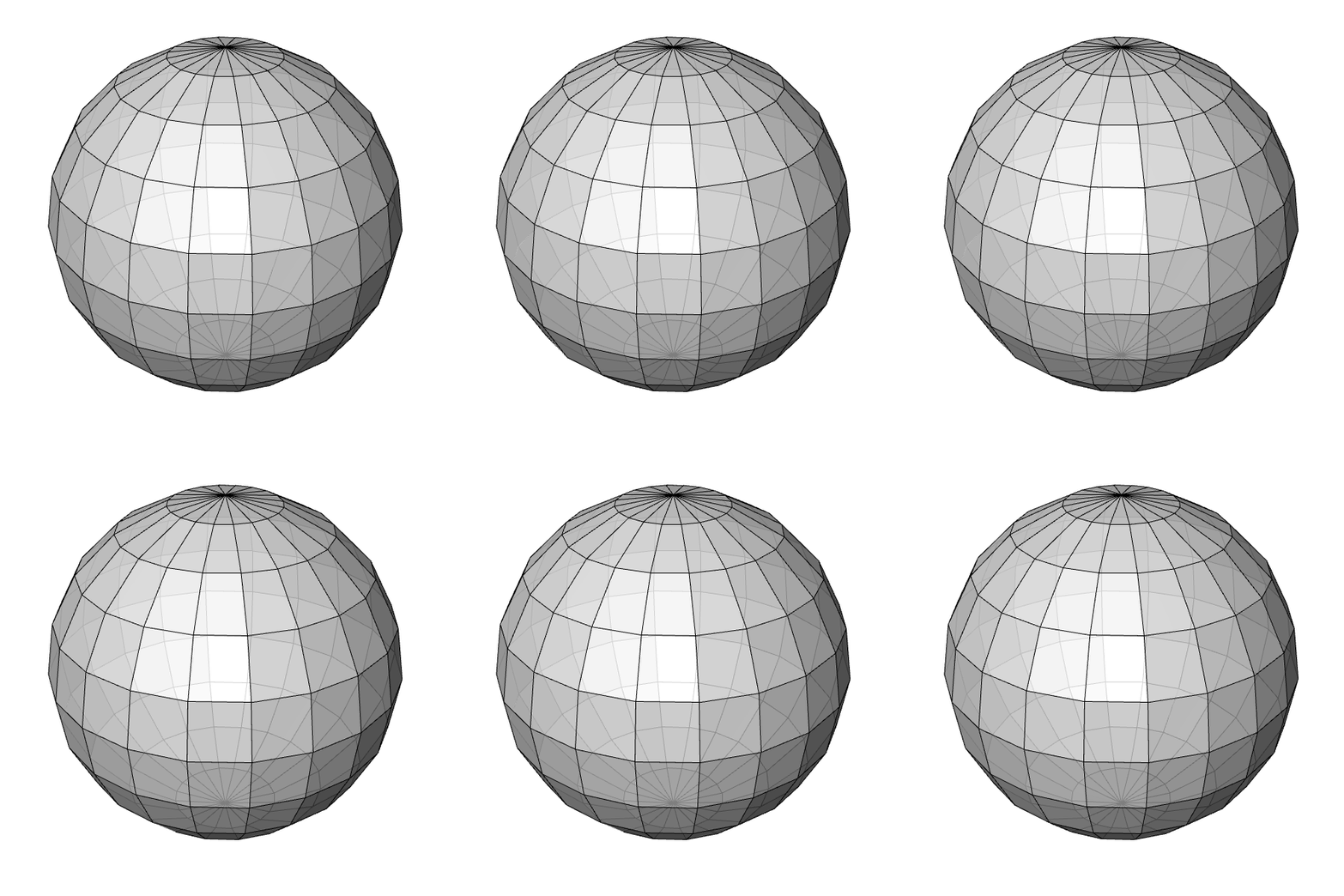
As I did more research, I saw that even more people were working on this solid. There was even information about it on Wolfram. But the most practical resource was on Moving Geometry, which I consider another legend. This explains how to derive these polyhedra in Rhino. Thanks to this very useful site, I came to understand how these polyhedra are derived via polygonal silhouettes. This next link provides a guide on how to produce these spheres using origami:
What initially seemed like a very boring and ordinary topic started to look genuinely fascinating when looking at the quality of the resources produced by the people who care about it. I wanted to join these people as well. I sat down at Grasshopper to try out some mischievous ideas that came to mind. Quite a few useful approaches can be developed in Grasshopper to make a “Septuaginta” (to use Luca Pacioli’s naming). Thinking about the methods that could be used to accomplish this made me realize once again what a wonderful geometry topic it is. In the end, the approach I chose was to go through polygons. When we rotate and copy a polygon in 3D around its own center, we can obtain the desired vertex set. Moreover, I figured we could generate different variations by playing with the number of sides of the polygon and experimenting with interesting designs by shifting and rotating the polygon.
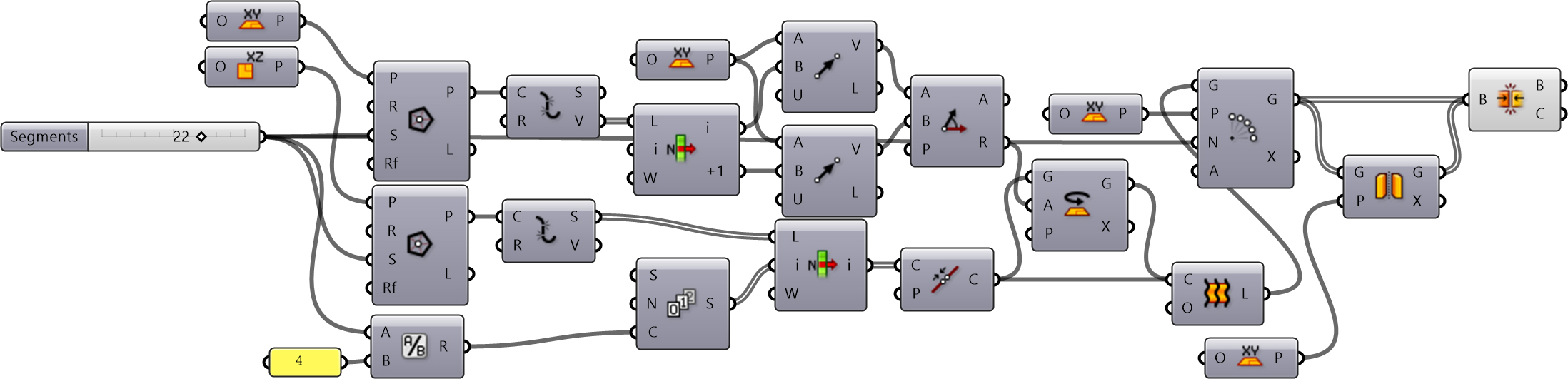
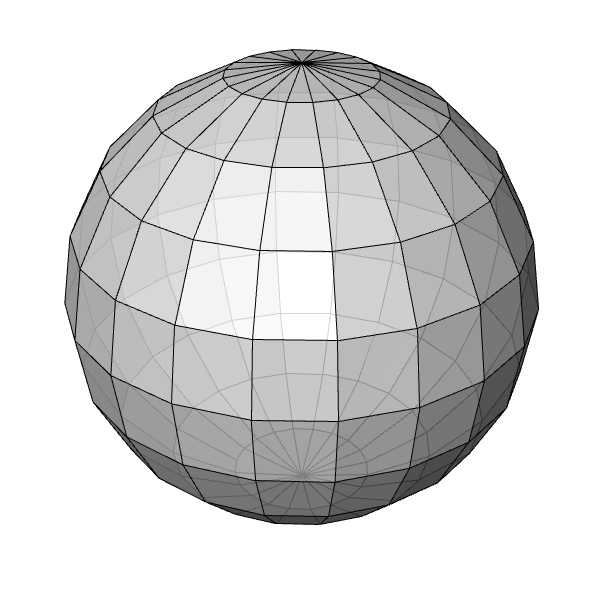
You will see a rather rigid modeling approach in the Grasshopper code. After choosing the main polygon with 2n sides (some of which aren’t true Campanus spheres because they don’t have a point at the poles, but I left them alone anyway because they are still interesting), we select the polylines in one of their quadrants. We then calculate the internal central angle of that polygon using a horizontal edge. This part could have been done much more easily. After rotating the quadrant polyline by the angle we obtained, we acquired a series of faces via a loft operation. The rest is completed into a sphere using Array Polar and Mirror. Now you can produce your own disco ball.
The takeaway we can bring home from this experience is that there are still some very high-quality and old resources on the internet. You just have to do a bit of archaeology to reach them.
Cite this post
Related Posts
Spherical Cycloid
April 2, 2024
Today’s beautiful curve is the spherical cycloid. It is a cycloid, rolling on a 3d circular path rather than a straight and 2d one. There are algebraic explanations of this curve. Therefore, I find it interesting to experiment with them, since it is more interesting than the regular planar cycloids, epicycloids, and hypocycloids. This curve is believed to have been studied first by Jean Bernoulli in 1732. The interesting and playful part of this is the resulting curve is always…
Fibonacci Sphere
April 12, 2023
This website explains the problem and several solutions. I managed to implement the formulas to convert a 2D square grid into spherical coordinates. The Fibonacci Sphere is one of the solutions to the equal distribution of points on a sphere. It is not the best solution to this problem. But it is regarded as a quick and efficient one. Suitable for me. I developed this Grasshopper code by studying the above website and some other sources. The code starts with…
Spherical Attraction
November 28, 2012
Today’s Architectural Geometry course was about platonic solids and different attractor objects in introducing component-based design systems. Benay’s idea was both pedagogical and interesting to test in Grasshopper. I searched for the most fundamental type of attractor solid in creating a composition such as this; There is a subdivided sphere and an attractor sphere. The pull component works great here. You may use multiple attractor solids or different shapes such as platonic solids as attractors. It is quite an easy…
Eschers Tessellations
March 29, 2012
After Puzzling, I tried to establish more of Escher’s basic grid transformations using Grasshopper’s native components. This definition simulates Escher’s transformation of four-cornered grids. The postulate is based on the fact that every quadrilateral (or triangular) planar shape can create regular tessellations without gaps or overlaps. In the traditional method, this tessellation is achieved by rotating the shape 180 degrees and copying afterward. However, in Grasshopper we simply define the fifth point for each shape and divide subsurfaces into four…
Sixty Square Sphere
February 21, 2013
This was a couple of weeks ago, together with my six-year-old son Mete, we decided to make a “ball” out of old memory cards. I was curious about a subdivision method, using only planar quadrilaterals to construct a sphere (named Sixty Square Sphere. There are a couple of models on www. Of course look much better than mine:=). However, my son was expecting a “ball” to play. Then, both of our expectations have been partially met, I think. You see…