
Variable Voronoi Study
I’ve been searching for a method to study the Voronoi subdivision in order to manipulate it. There are well-known algorithms for that. But I thought it would be better if I use a projective approach just as I did in studying hyperbolic space (here). This is the metaphor of inflating balloons. However, I inflated cones instead of spheres. This way, it became possible to modify the algorithm. So I was able to develop a kind of variable Voronoi study here. Of course, it is not a real Voronoi because the edges are not straight.
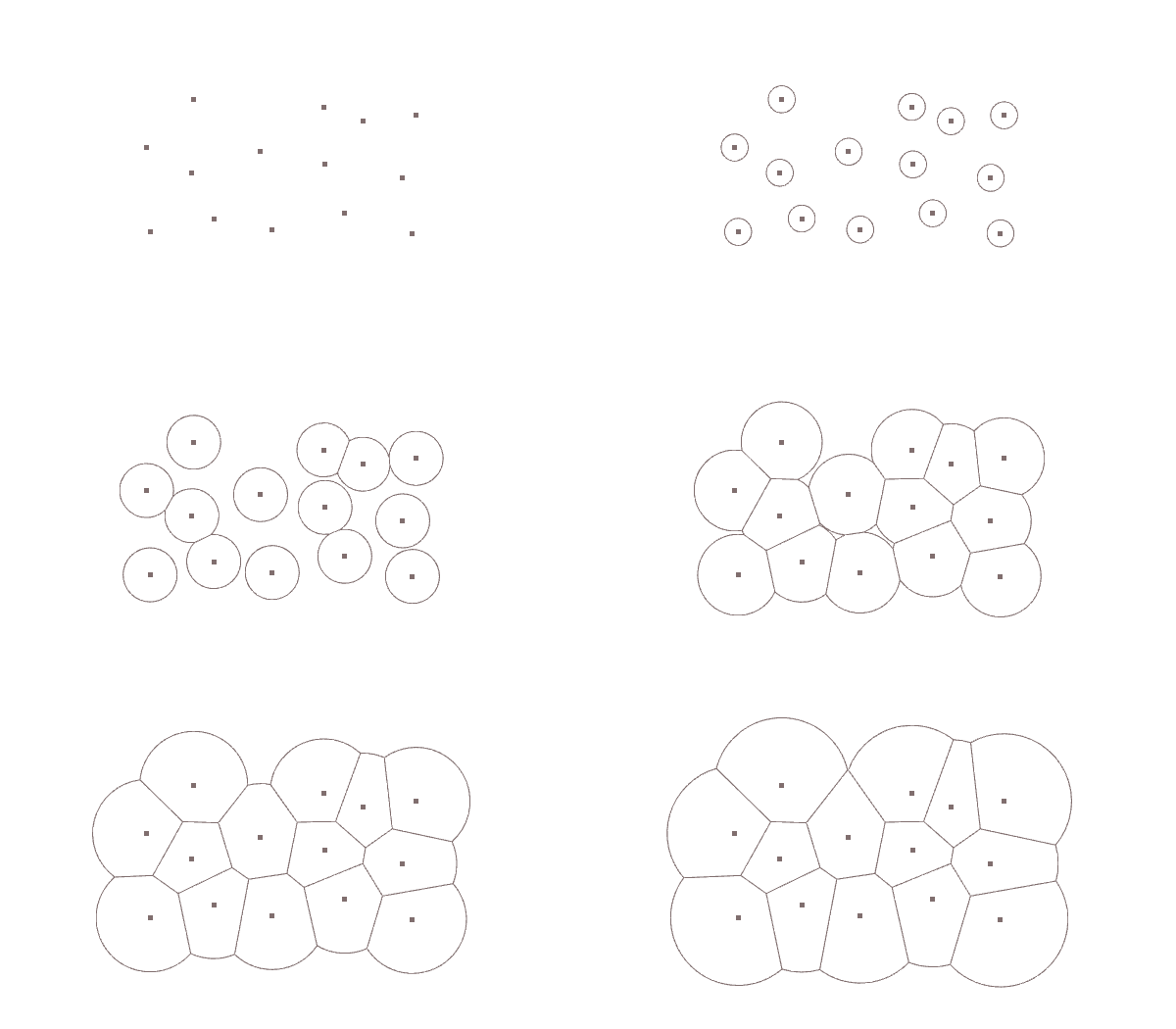

Above is the regular Voronoi subdivision in 5 steps, with constantly and equally inflating points. As a result, the code is very simple and easy to use. It is a good educational experiment on the usage of projections and intersections in native Grasshopper.
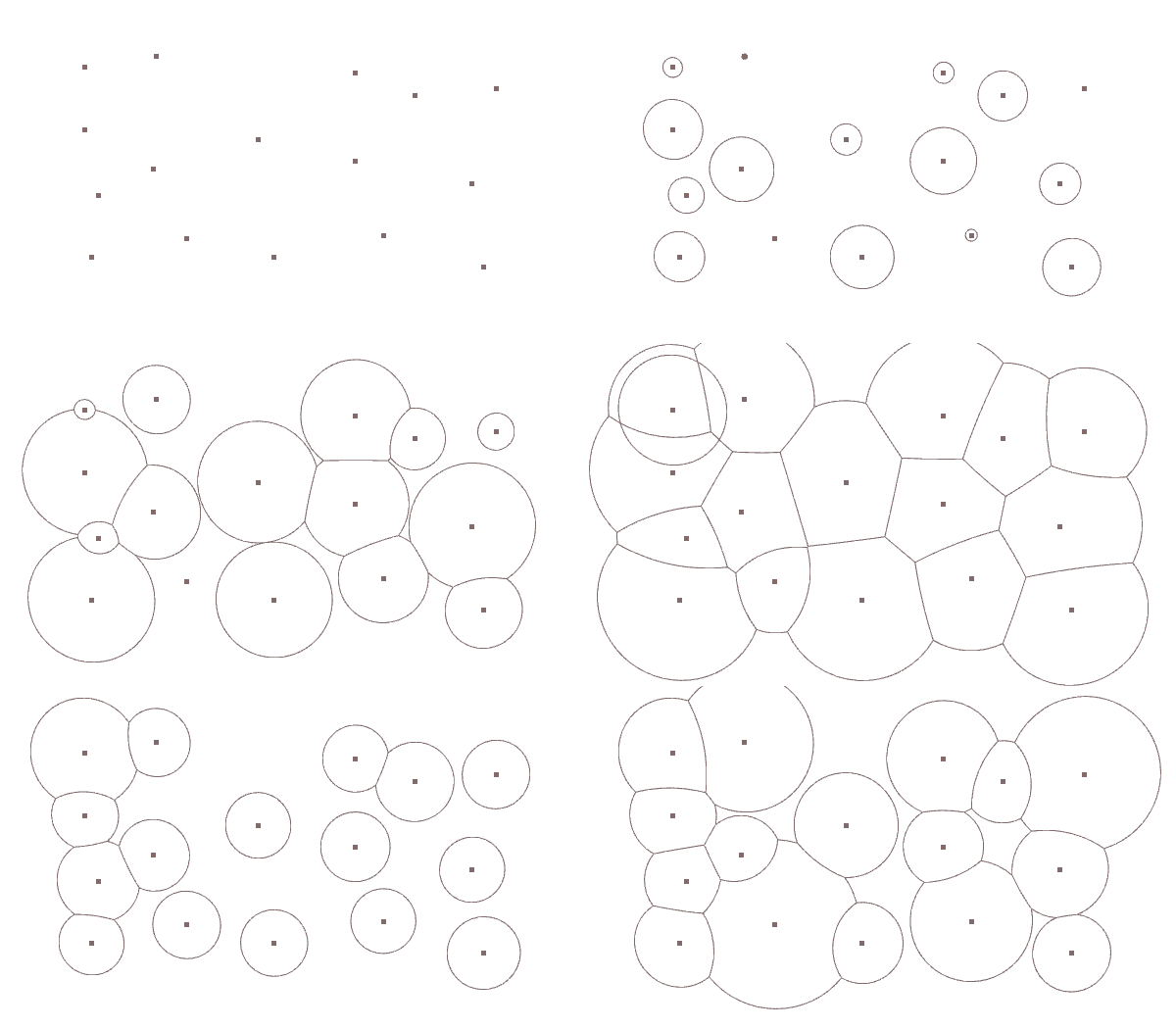
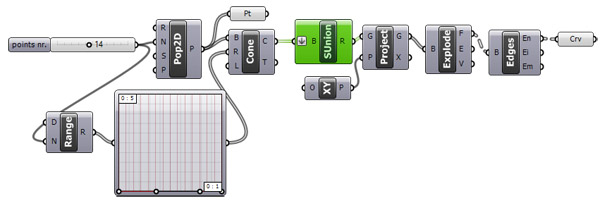
The second attempt (above) shows an interpretation of the variable Voronoi study. Again I inflated points at variable distances. Curved edges are because of different cone heights. You can study linear edges by manipulating those heights to be the same. And finally, I tried to put attractor curves, in addition to points in this algorithm. Thus I put spheres instead of cones. Look what happened;
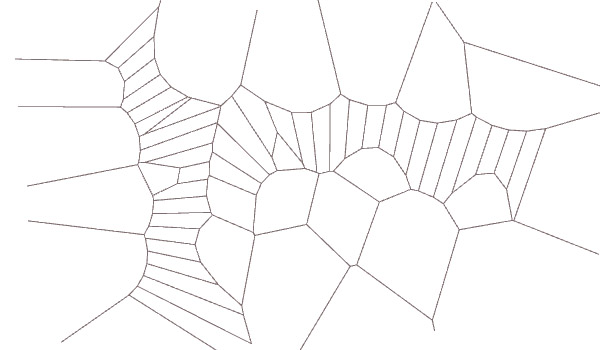
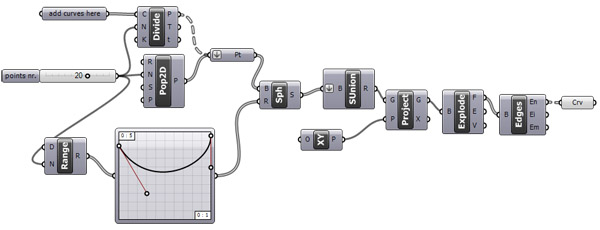
Straight edges and variable effect from each point. Here is the working Rhino 5 Grasshopper file from 2012. This code still works in 2021. Because it was made by using the native Grasshopper components. This makes the code more durable, simple, and educational. Here is a link that inspired me to this study. This post could be further improved by studying various components and sweeping objects along curves.
Cite this post
Related Posts
Voronoi Cage
June 26, 2023
I have created a straightforward Grasshopper code that generates a Voronoi diagram on a surface. Then, it adds thickness to form a structure called a “Voronoi Cage.” In the initial step, I project a surface onto the ground plane (Z=0). The projected frame serves as the boundary for two operations: generating random points using the Populate 2D (Pop2D) function and calculating the Voronoi diagram based on these points. The resulting Voronoi cells are then slightly offset inwards. Moving on to…
3D Voronoi Puzzle
May 3, 2023
Here, our aim is to generate a 3D Voronoi puzzle ready for 3D printing. Below is the step-by-step explanation of this Grasshopper algorithm: The 3D Voronoi Puzzle Step number one is the application we saw earlier in the Voronoi diagrams. We obtain random polyhedra within a given volume quickly. The basic features we need for the puzzle are: (1) When we solve the puzzle the final volume should be a cube. (2) We should control the dimensions of the total…
Voronoi Puzzle
April 5, 2023
In this Voronoi puzzle exercise, we derive two-dimensional puzzles by using Voronoi diagrams. This is similar to my previous studies here, and here. Part 1: The Random Voronoi Diagram In section 1 of the below image, I use a rectangular region to generate random points. Then, I create a standard Voronoi diagram by using those points. Finally, I explode the Voronoi cells. Part 2: The Voronoi Puzzle Details In the second part, we draw an arc on the edges of…
Image Sampler Revisited
March 17, 2015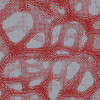
Image Sampler of Grasshopper saves life if used responsibly. While explaining the component to this year’s ARCH362 students, I used this simple example that generates numbers from a beautiful picture of “metal foam” and uses it to generate lots of circles: Metal foams are lightweight but strong materials, that are typically produced by injecting gas into the liquid metal. Of course, it becomes easier to teach something when you manage to attract the attention of students.
Karyokinesis
November 2, 2013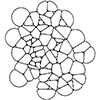
While searching for a way to work with random points and growing populations, this idea appeared accidentally. I wasn’t trying to mimic the behavior of Karyokinesis of biological cells (in fact I’m in serious doubt about biomimicry in general). The trick is to use a timer + data recorder + a knob for the arbitrary user input. It starts to breed when you start the timer, but to change the evolution speed, just roll the knob! Of course, the knob…