
Work of Art in the Age of AI
In his groundbreaking 1935 text ‘The Work of Art in the Age of Mechanical Reproduction,‘ Walter Benjamin questioned how photography and cinema radically transformed the nature of art. According to him, what made a work of art unique was its singular existence in time and space, its ‘aura’. Mechanical reproduction techniques shook this aura, detaching the work from its traditional context and offering it up for mass consumption. Today, we stand at a completely different threshold. Generative AI tools are reviving Benjamin’s early 20th-century concerns and insights on the digital plane of the 21st century. When we modify certain words in an excerpt adapted from Benjamin’s text below, a striking mirror emerges for rethinking the relationship between artificial intelligence and creativity in art and design.
Even the most perfect reproduction of a work of art is lacking in one element: its presence in time and space, its unique existence at the place where it happens to be. This unique existence of the work of art determined the history to which it was subject throughout the time of its existence. […] One might subsume the eliminated element in the term ‘aura’ and go on to say: that which withers in the age of mechanical reproduction is the aura of the work of art. This is a symptomatic process whose significance points beyond the realm of art. One might generalize by saying: the technique of reproduction detaches the reproduced object from the domain of tradition. By making many reproductions it substitutes a plurality of copies for a unique existence. And in permitting the reproduction to meet the beholder or listener in his own particular situation, it reactivates the object reproduced. These two processes lead to a tremendous shattering of tradition which is the obverse of the contemporary crisis and renewal of mankind. […]
The uniqueness of a work of art is inseparable from its being imbedded in the fabric of tradition. […] An analysis of art in the age of mechanical reproduction must do justice to these relationships, for they lead us to an all-important insight: for the first time in world history, mechanical reproduction emancipates the work of art from its parasitical dependence on ritual. To an ever greater degree the work of art reproduced becomes the work of art designed for reproducibility. […] But the instant the criterion of authenticity ceases to be applicable to artistic production, the total function of art is reversed. Instead of being based on ritual, it begins to be based on another practice—politics.
Even the most perfect AI-generated output is lacking in one element: its presence in time and space, its unique existence at the place where it happens to be. This unique existence of traditionally crafted art determined the history to which it was subject throughout the time of its existence. […] One might subsume the eliminated element in the term ‘aura’ and go on to say: that which withers in the age of AI generation is the aura of AI-driven art. This is a symptomatic process whose significance points beyond the realm of technology. One might generalize by saying: the technique of algorithmic modeling detaches the reproduced object from the domain of tradition. By making many prompt-based variations it substitutes a plurality of copies for a unique existence. And in permitting the synthetic output to meet the beholder or listener in his own particular situation, it reactivates the object reproduced. These two processes lead to a tremendous shattering of tradition which is the obverse of the contemporary crisis and renewal of mankind. […]
The uniqueness of a work of art is inseparable from its being imbedded in the fabric of tradition. […] An analysis of art in the age of artificial intelligence must do justice to these relationships, for they lead us to an all-important insight: for the first time in world history, generative AI emancipates art from its parasitical dependence on human ritual and master-craft. To an ever greater degree the AI-reproduced becomes the art designed for infinite algorithmic reproducibility. […] But the instant the criterion of authenticity ceases to be applicable to artistic production, the total function of art is reversed. Instead of being based on traditional craft, it begins to be based on another practice—data politics and commercial distribution.
This adaptation shows how the shaking of ‘originality and aura’ that Walter Benjamin described for photography and cinema in 1935 parallels today’s generative AI tools. Just as mechanical reproduction shook the sacredness and uniqueness of art back then, today AI algorithms are disrupting the conventional production process of art and opens new discussions on the concept of creativity.
Cite this post
Related Posts
A Sartrean Criterion for AI Consciousness
August 4, 2026
In this article, I will attempt a small intervention in contemporary artificial intelligence discussions with an old philosophical example. Our hypothesis is this: ”Artificial intelligence is very powerful at defining and reproducing existing patterns. However, experiencing that which is not there, absence, negation, and nothingness, as a lived condition belongs exclusively to human consciousness.” Jean-Paul Sartre, in his famous “Cafe Example” from his 1943 work “Being and Nothingness“, describes the experience of someone entering a crowded cafe to find a…
Intra)/value
August 16, 2026
The group exhibition 2 Years 10 Meters, curated by Natalia Schmidt, opened on April 24, 2024, at the Cité Internationale des Arts in Paris. My name was also included in the exhibition due to the projection graphics in Didem Yalınay’s artwork Intra)/value. This was another step in Didem’s long-term project. She hated being called a “Digital Artist.” She produced wonderful works with Seçkin Maden. I was fortunate enough to accompany her as a modest collaborator on one of her pieces….
More Swirly Flames
March 21, 2023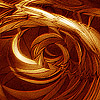
This is a return to the Swirly Flames tutorial I made in 2013 here. Since then, Photoshop changed a bit. There is no more Variations tool. Therefore, I had to use other tools such as Color Balance, Hue/Saturation, Inverse, etc. to achieve the same effect. It is still cool for me, personally, although we are in the age of AI-generated images now. It is not the visual result only, but the memories it carries until today. Nowadays, I am translating…
String Art in Rhino Python
June 19, 2025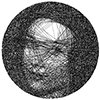
String art is a cool art technique that combines geometry and aesthetics to recreate images using lines between pins. Here is a good reference to start studying it. In this post, I explored a custom Rhino Python script designed for Rhinoceros 7 and 8. It transforms a grayscale image into a dense web of threads. The algorithm analyzes the darkest areas of the image and connects pins in a circular layout to form compositions. The script begins by converting a…
ASCII Art in Grasshopper
August 24, 2024
ASCII art is a graphic design technique that uses characters from the ASCII (American Standard Code for Information Interchange) set to create images, symbols, and designs. This form of art involves arranging text characters to form a visual representation of objects, scenes, or abstract patterns. I first encountered this art form in the 90s through readme text files and computer games. Years later, attempting to automate it in Grasshopper was a lot of fun. My initial goal was to calculate…