
Euclidean Construction of Rhombitrihexagonal Tiling
The rhombitrihexagonal tiling is one of the semi-regular tessellations. It is composed of regular hexagons, squares, and triangles. It is a periodic tessellation since you can copy the fundamental unit and move it across the plane to generate the tiling. I use this quality of the tiling to draw and expand it in Rhinoceros software. This is a basic drawing exercise. At the same time, it is a nice exercise for the mind and sometimes for the soul. There are only 8 such tilings that fill a 2D plane without gaps or overlaps. I made the Euclidean construction of rhombitrihexagonal tiling with an abstract compass and straightedge. So, the step-by-step process is fully deterministic and precise, though not requiring any numerical input.
The rhombitrihexagonal tiling is also named 3.4.6.4 since at any vertex, these are the polygons around it. It is one of the regular lattices for circle packings.
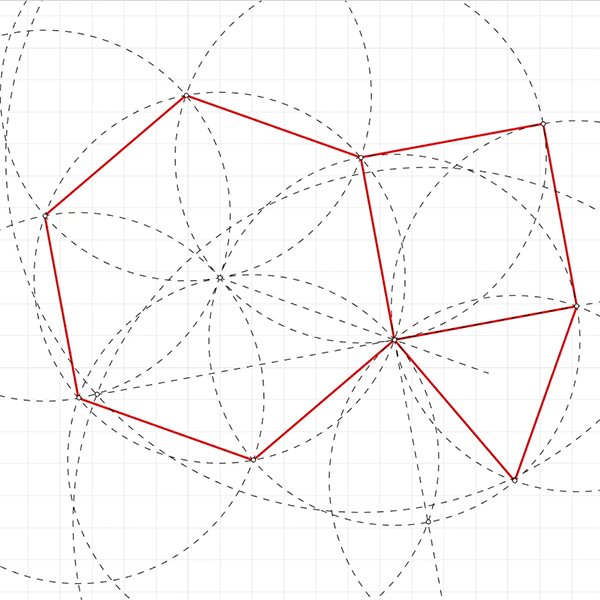
This was the first time I drew this tiling with the Euclidean construction method. It is quite possible to generate this tiling in Grasshopper or any other programming language. However, drawing in Rhino or any other CAD software seems to be an educational and relaxing experience. I start the Euclidean construction of rhombitrihexagonal with a random line on the plane. The process includes the drawing of the regular hexagon with a series of compass operations. Then, I proceed by finding the right angle direction, normal to any segment of this hexagon. This requires two identical intersecting circles that are on the same axis as the segment. The radius of these circles doesn’t matter as long as they intersect. Also, this requires the distance transferring via the copy command in Rhino.
Cite this post
Related Posts
Constructing Irregular Tiling
December 11, 2024
Using a compass and straightedge enables precise geometric constructions, allowing for the creation of complex tessellations. To begin these constructions, a single starting point is sufficient. Circles, which represent a collection of points at a specific distance from the center, and straight lines, which represent a collection of points in a particular direction, are utilized for geometric constructions. In this short tutorial, we move on with the beginner-level drawing exercises. This time, I am drawing an irregular tiling with triangles…
Constructing Snub Square Tiling
December 11, 2024
Snub Square Tiling is a semi-regular tessellation of the plane, composed of two squares and three regular triangles at each vertex. The arrangement of these two regular shapes seamlessly covers the plane without any gaps or overlaps. It is one of the eight semi-regular tessellations known in geometry. The dual of Snub Square Tiling is Cairo Pentagonal Tiling, which we will explore later. In this short tutorial, I am drawing and constructing the Snub Square Tiling by using an abstract…
Euclidean Construction of Snub Square Tiling
February 28, 2024
The snub square tiling is one of the semi-regular tessellations, where regular triangles and squares match perfectly to fill the plane without gaps or overlaps. The Euclidean construction of Snub Square tiling is possible by utilizing the basic compass and straightedge operations. I made this construction in Rhinoceros to show that there is no need for any numerical input to locate the points and draw the tiling. There are two major techniques explained there. One of them is the basic…
Drawing Kagome Tiling
December 11, 2024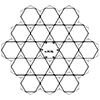
In Japanese, “kagome” refers to basket weaving, and the name of this tiling derives from the traditional basket-weaving craft of Japanese culture. In geometry, we know Kagome tiling as a semi-regular tessellation, Tri-Hexagonal Tiling. This tiling is composed of regular hexagons and triangles that cover the plane completely without gaps or overlaps. The dual of this tiling is the Rhombille Tiling. In this short tutorial, I am explaining the drawing of Kagome tiling in Rhinoceros. Thus, I am using some…
Drawing Koch Pentagon
December 11, 2024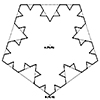
The Koch pentagon is a fractal shape that starts with a regular pentagon. Here, we divide each side of the pentagon into three equal parts. Then, we replace the middle with two sides of an outward-pointing equilateral triangle. We repeat this process for every new side in each iteration, creating a self-similar pattern. Helge von Koch (1870–1924) was a Swedish mathematician known for his analysis and number theory work. He is most famous for introducing the Koch snowflake, one of…