designcoding
About Table of Contents Keywords Monthly Archive
Support designcoding!

Drawing Escher-like Tiling

December 11, 2024
Escher tilings, inspired by the work of Dutch artist M.C. Escher, are inspiring tessellations that cover a plane using repeated geometric shapes without gaps or overlaps. He often used interlocking, recognizable figures like animals and birds to create these patterns, blending art with mathematical precision. His tilings explore symmetry, transformations, and the interplay between two- and three-dimensional space. Escher’s work has influenced both artistic and mathematical fields, particularly in the study of tessellations and geometry. Thus, In this short tutorial,…
Constructing Snub Square Tiling

December 11, 2024

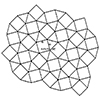
Snub Square Tiling is a semi-regular tessellation of the plane, composed of two squares and three regular triangles at each vertex. The arrangement of these two regular shapes seamlessly covers the plane without any gaps or overlaps. It is one of the eight semi-regular tessellations known in geometry. The dual of Snub Square Tiling is Cairo Pentagonal Tiling, which we will explore later. In this short tutorial, I am drawing and constructing the Snub Square Tiling by using an abstract…

Drawing Kagome Tiling

December 11, 2024

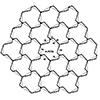
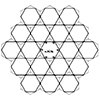
In Japanese, “kagome” refers to basket weaving, and the name of this tiling derives from the traditional basket-weaving craft of Japanese culture. In geometry, we know Kagome tiling as a semi-regular tessellation, Tri-Hexagonal Tiling. This tiling is composed of regular hexagons and triangles that cover the plane completely without gaps or overlaps. The dual of this tiling is the Rhombille Tiling. In this short tutorial, I am explaining the drawing of Kagome tiling in Rhinoceros. Thus, I am using some…

Drawing Hexaflake

December 11, 2024

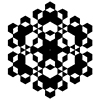
The term “hexa” generally refers to the number six, derived from the Greek word. It is commonly used in mathematics, geometry, and other scientific fields to indicate six-sided shapes or structures. A hexagon is a polygon with six sides and six angles. It is one of the regular polygons, meaning all of its sides and angles are equal. A hexahedron is a polyhedron with six faces. The most well-known example is the cube, which has six square faces, twelve edges,…

Drawing Koch Pentagon

December 11, 2024

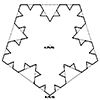
The Koch pentagon is a fractal shape that starts with a regular pentagon. Here, we divide each side of the pentagon into three equal parts. Then, we replace the middle with two sides of an outward-pointing equilateral triangle. We repeat this process for every new side in each iteration, creating a self-similar pattern. Helge von Koch (1870–1924) was a Swedish mathematician known for his analysis and number theory work. He is most famous for introducing the Koch snowflake, one of…

Constructing Tangent Circles

December 11, 2024

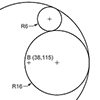
In geometry, “tangent” refers to a scenario where a line, curve, or surface touches another at exactly one point without crossing or leaving a gap. A tangent line to a circle is a straight line that touches the circle at only one point, and it is perpendicular to the radius at that point. Two circles can be tangent either internally or externally. Geometric constructions using a compass and straightedge can help accurately calculate tangent circles. Thus, the “constructing tangent circles”…

Constructing Irregular Polygons

December 11, 2024

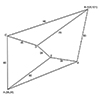
The geometric shapes constructed using only a compass and straightedge have significantly influenced the development of reasoning and logic that underpin modern science. This non-numerical approach is also known as the Synthetic Geometry. Before René Descartes introduced Analytic Geometry, this method was widely studied and practiced. In “Elements”, Euclid explores fundamental rules, such as ‘The straight line between two points is the shortest,’ and derives all geometric truths from simple, observable principles, built up step by step through logical deduction….

Constructing Regular Polygons

December 11, 2024

The practical geometry of the ancient Egyptian “rope-stretchers” delineated land after the annual flooding of the Nile River. Thus, the term “geometry” derives from the Greek words “gaia” (earth) and “metria” (measurement). Greek mathematicians used compass and straightedge to perform similar calculations on paper. This abstract thinking allowed for insights into the underlying logic, independent of the accuracy of hand tools. So, the abstract “circle” and “line” constructed by perfect compasses and straightedges can be seen as a reflection of…

Drawing Polygon Spiral

December 11, 2024

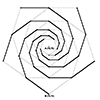
A spiral is a curve that begins at a central point and continuously moves outward, either getting larger (in an outward spiral) or smaller (in an inward spiral). It often revolves around a central point or axis. Spirals are fascinating because they appear in many aspects of nature, mathematics, and art. In this drawing exercise, I utilized several commands to draw such a system. However, this drawing is not a curved spiral but rather a segmented one. In this basic…

Drawing Fractal Tree

December 11, 2024

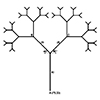
A fractal is a complex geometric shape that we can split into parts, each of which is a reduced-scale copy of the whole. This property is self-similarity. Fractals often exhibit patterns that repeat at different scales. We can find fractals in nature, such as in snowflakes, mountain ranges, trees, and clouds. We can also generate them mathematically. Fractals have applications in various fields such as physics, biology, and computer graphics. We use them to model natural phenomena, compress data, and…

« 1 2 3 4 5 6 7 8 9 10 11 12 13 14 15 16 17 18 19 … 57 58 59 »
  • Chapters

    • Algorithms
    • Discourses
    • Fabrications
    • Studios
  • Explore

    • Table of Contents
    • Monthly Archive

    • All Keywords
    • #sinan
    • #regulations
    • #buckminster-fuller
    • #hotwire-cutting
    • #dual
    • #ice-ray
    • #islamic-pattern
    • #tree
    • #moebius
    • #kangaroo
    • #space-filling
    • #packing
    • #geodesic
    • #chaos
    • #spiral
    • #text
    • #macro
    • #terrain
    • #landscape
    • #koch
  • Search

  • Support designcoding!

  • Enjoying designcoding? Support me on Patreon to keep it growing. Thank you!

  • copyright 2026 designcoding.net | about | privacy policy | end user license agreement