
Modeling and Unrolling Icosidodecahedron
An icosidodecahedron is a polyhedron that is part of the family of Archimedean solids. It has 32 faces, consisting of 12 regular pentagonal faces of a dodecahedron and 20 regular triangular faces of an icosahedron. It is highly symmetrical, with the same arrangement of faces around each vertex. In this short tutorial video, I am modeling and unrolling an icosidodecahedron. This polyhedron is very interesting and is mostly used as a basis for more sophisticated designs. Its dual polyhedron is a rhombic triacontahedron, a Catalan solid. I especially love this Catalan solid because of its rhombic appearance. This is why, the icosidodecahedon is a good starting point to create a model of that.
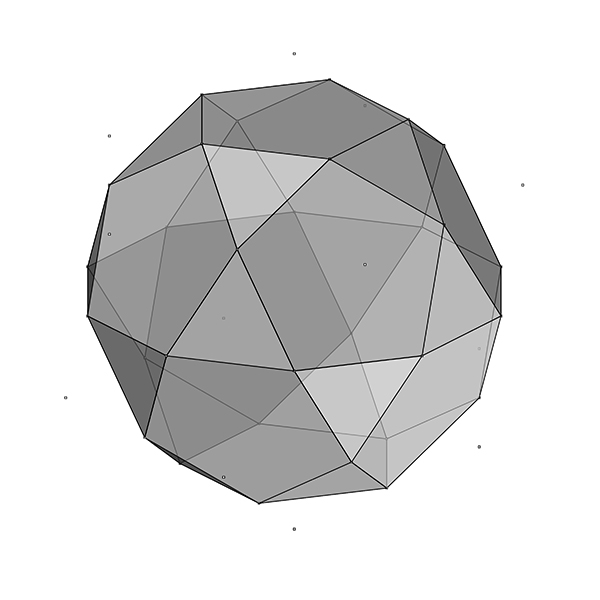
I have been conducting a series of in-class exercises in the freshmen year architectural geometry course, focusing on Euclidean constructions, basic drawing and transformation commands, introductory fractals, regular and semi-regular tessellations, patterns, modeling, and unrolling polyhedra using Rhinoceros software. Junior architects, interior designers, industrial designers, and enthusiasts from other disciplines can benefit from these concise drawing exercises. I will publish exercises every week on my blog and other platforms. So, today’s exercise is modeling and unrolling an icosidodecahedron.
The software used in this course is Rhinoceros 3d (www.rhino3d.com). However, if you want to find out more and see the whole list of this video series, you can check my YouTube channel at www.youtube.com/@designcodingnet. The music of this video is ‘This Too Shall Pass’ by Scott Buckley (CC-BY 4.0). www.scottbuckley.com.au
Cite this post
Related Posts
Modeling Truncated Icosidodecahedron
December 15, 2024
In geometry, a truncated icosidodecahedron, rhombitruncated icosidodecahedron, great rhombicosidodecahedron, omnitruncated dodecahedron, or omnitruncated icosahedron is an Archimedean solid. It is one of thirteen convex, isogonal, non-prismatic solids constructed by two or more types of regular polygon faces. In this short tutorial, I am constructing an irregular truncated icosidodecahedron. It is not the regular Archimedean solid, but a rough approximation of it. I made this model to exercise the exploration of new polyhedra by using rectification and truncation operations. Nevertheless, here…
Icosidodecahedron
December 22, 2011
Icosidodecahedron is an Archimedian Solid, a thing in between the Platonic Solids of Icosahedron (d20) and Dodecahedron (d12). It is a rectified version of an Icosahedron, constructed by dividing every edge into two equal segments and joining these segments to create a composition of equilateral pentagons and triangles. Archimedian Solids consist of at least two equilateral polygons, whereas Platonic Solids are constructed by only one. We’ll deduce an Icosidodecahedron from Icosahedron below; First, you should create an Icosahedron, the Platonic…
Modeling and Unrolling Buckyball
December 14, 2024
A Buckyball, (or Fullerene), is a molecule of 60 carbon atoms with a structure resembling a soccer ball. It is a specific type of fullerene, often referred to as C60, where the carbon atoms form a series of pentagons and hexagons in a pattern that creates a spherical shape. This structure is similar to the arrangement found in a truncated icosahedron, with 12 pentagonal and 20 hexagonal faces. The buckyball is named after architect Buckminster Fuller, who popularized geodesic domes,…
Modeling and Unrolling Truncated Tetrahedron
December 14, 2024
Truncation in mathematics and geometry refers to cutting off parts of a shape, typically the vertices, edges, or other extremities, to create a new modified figure. This process is often used with polygons, polyhedra, or functions. A truncated tetrahedron is a polyhedron we can derive from a regular tetrahedron by truncating (cutting off) its four vertices. This process creates a new shape with additional faces while maintaining its symmetry. In this tutorial video, I am modeling and unrolling a truncated…
Modeling and Unrolling Truncated Tetrahedron
March 10, 2024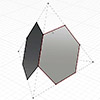
Truncation refers to the process of shortening something by removing parts. You can apply truncation to numbers, text, or data in various contexts. A truncated polyhedron is a geometric solid formed by truncating the vertices of a regular polyhedron. Truncation involves cutting off the corners or vertices of the polyhedron in such a way that the original faces become polygons with new edges. This process creates new faces at the truncated vertices. It often results in a shape that is…