
M.Arch in Computational Design at İstanbul Bilgi University
I have been coordinating the Graduate Program in Architectural Design at Istanbul Bilgi University since last year. I would also like to note down some information about the program here.
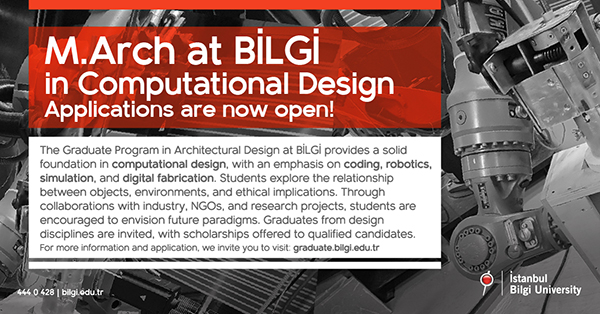
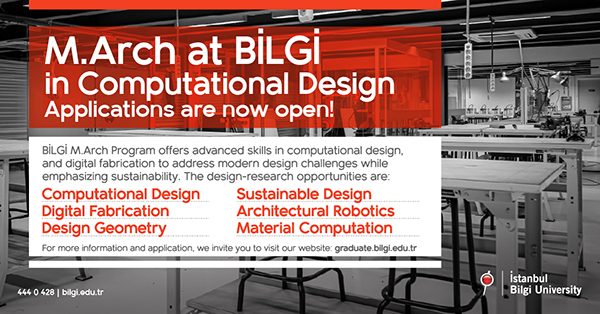
The Graduate Program in Architectural Design at İstanbul Bilgi University is positioned at the intersection of design, technology, production, and sustainability. It aims to equip designers and architects with advanced skills in computational design, coding, material research, robotics, and digital prototyping. Additionally, it introduces the fundamental principles and concepts of sustainability. By emphasizing the environmental, social, and economic impacts of design, the program encourages students not only to master new technologies but also to contribute to a more resilient and low-carbon future. This goal is pursued through collaboration with social projects, industrial partnerships, and non-governmental organizations, aiming to become a hub that develops open-source innovations.
The Architectural Design Graduate Program is built around a combination of theoretical coursework, practical design Research Labs (a.k.a. studios), and attached research projects. Research Labs carry the most weight, emphasizing hands-on learning, application, and professional practice. The compulsory courses are spread across a variety of topics to support these labs from various skill sets and theoretical backgrounds.
For more information and application, you can visit the program website.

Cite this post
Related Posts
Algorithm in Architectural Education Studio Works
April 30, 2013
This is an old research paper, prepared with Birgül Çolakoğlu. It is in Turkish and includes our first results in some of the Rhinoscript exercises. Here is the abstract of the paper; Recent research in architecture have focused on to understand computational methods of formal exploration and expression. Computational mechanisms have been used to readdress formal issues using new techniques and methods. Computational tools that operate on algorithmic logic are central in these explorations. Despite the proliferation of computers in architecture today, use…
Designing the Design Studio
March 5, 2013
In 2007, we conducted a computational design studio in YTU / CADU with Birgül Çolakoğlu. Below is the brief of the paper published at METU JFA Vol24 issue 2 titled “An Innovative Design Education Approach: Computational Design Teaching For Architecture”. We were dealing with how new technologies are affecting the design cycle. Rhinoscript is used as an educational tool, and various short exercises are conducted with it. After 6 years, I still think of ways how to construct a proper…

Architectural education in its relation to computational technologies is both becoming a part of these studies and having the potential of renovating itself with the knowledge of emerging technologies. This paper, in this framework, will be presenting a design research studio that aims at developing relational thinking capabilities in the computational design process. In this studio, topics of parametric design, parametric modeling, and relationality were questioned through the design process. In the 2006-2007 spring semester in the Graduate Studio II…
Digital Exercises in Architectural Design Studio
February 26, 2013Studio exercises are short-term and open-ended design activities that represent a constructivist learning approach by limiting design domains. They are student-centered, model and process-oriented educational tools. These qualities make studio exercises potential tools for integrating contemporary Digital Design thinking into architectural education. This research aims to reveal these potentials by defining an analytical perspective and logical connections between the pedagogical intentions of studio exercises and the theory of Digital Design. The first chapter of this research includes a definition of…
Pedagogical Pattern Languages
July 24, 2012Joseph Bergin‘s pedagogical patterns for computer science education returned my attention to teaching methods I’ve searching for almost five years. Here is a phrase from a paper submitted to pedagogical pattern language project: Most educators and trainers are not taught how to teach. Rather, they often find themselves teaching by accident. Typically, a person with a skill that is in demand, such as a particular programming language, will be asked to teach it. People assume that if the person is good in this…