
Lanterns Project: Computation-based Basic Design Studio
In the first-year Computation Based Basic Design studio at İstanbul Bilgi University, the aim is to help students understand that design, due to its prevalent relational nature incorporates different forms of reasoning as indispensable constituents within the creative process (Yalınay Çinici, 2013). The studio integrates the 1:1 scale construction via computational thinking which consists of geometric relations, material computation/performance, and CAD/CAM technologies. The aim of the studio is to develop an awareness of immediate or far surroundings in terms of shapes, forms, figures, colors, textures, and materials in different scales through abstraction and conceptualization. The same construction method is also applied in two-dimensional tessellations. Tessellations are dealing with the problem of covering an area without gaps or overlaps. Students learn how to create tessellations with increasing complexity by only defining simple geometric rules, such as truncation and duals. Such methods are also re-utilized in the future subject of polyhedra.
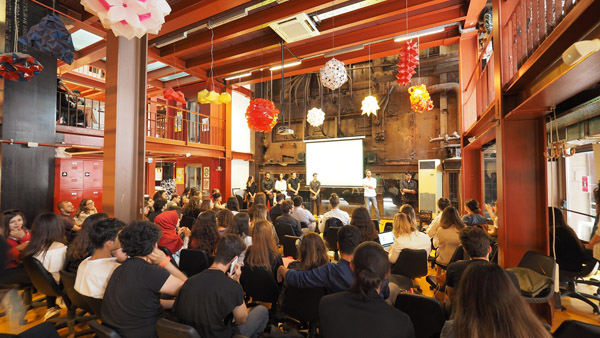
Photo: Caner Bingöl
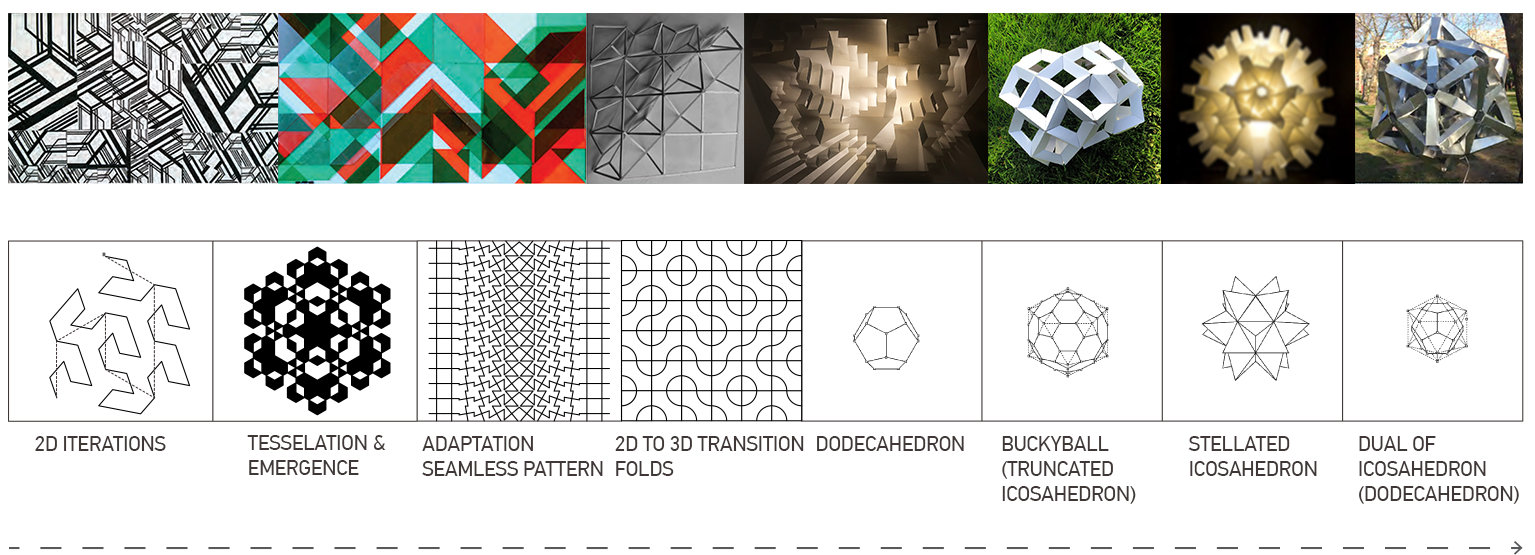
The Computation-based Basic Design studio is structured to explore design space through tasks with gradually increasing complexity, in 2D and 3D by focusing on a hands-on approach through material performance as well as geometric relations. The studio operates on individual critiques based on the tangible work and interpretation of the students to given tasks, by at least three instructors with diverse backgrounds and approaches to design. The collaborative teaching method allows for the creation of an environment of dialogue that is constantly evolving, encouraging students to reflect on their design process. Figure 1 shows the synchronical relationship between the Computation-Based Basic Design Studio and the Design Geometry course. The studio exercises begin with two-dimensional rule-based patterns and evolve into multi-layered and multi-dimensional design systems by applying different materials and production techniques. Before initiating the final project, there are preliminary studies on integrating digital modeling and fabrication of polyhedral shapes and material computation. In the project named “Structural Components”, students are asked to span a predefined distance by combining given pieces of cardboard with predefined dimensions. They are encouraged to think about creating components out of these pieces, by considering their combination potential to seek multiplicity. The structural requirement of the exercise motivates students in creating three-dimensional sections, resulting in research for more complex relationships. This exercise benefits from the pattern deformation study of the Design Geometry course and helps students to elevate the pattern deformations into component-based three-dimensional structures with intrinsic variations. The “Lanterns Inside” was another short-term individual project, aiming to introduce students to the geometric basis of polyhedra, material properties, and joint details. Students analyze and study precedents made of various materials and forms. They experiment with various approaches to achieve three-dimensional and
volumetric outcomes, composed of rule-based component systems. The initial ideas raised from this project are further developed in the final project that fit a larger scale and outdoor conditions.
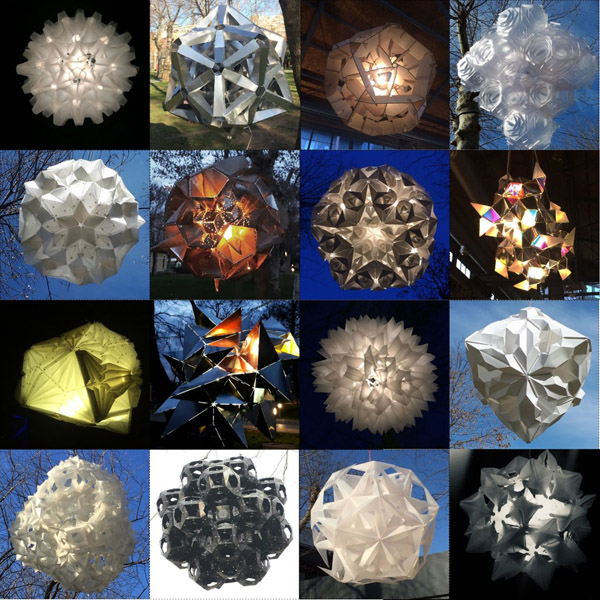
Case Study: “The New Year’s Lanterns”
The individual projects explained above lead to the final assignment of the semester where students work in groups to design and construct a lighting element suitable for outdoor use. Students are encouraged to investigate the geometrical relations, and material performances, and develop custom joinery details considering the effect of light, regarding reflections, shadow, transparencies, etc.
This study is presented at eCAADe 2018 Conference in Lodz, Poland. For the rest of the paper, you can visit here
Cite this post
Related Posts
Basic Design Lanterns Project: 2019
March 22, 2019
This is a student project of the Computation-based Basic Design Lanterns finals of the year 2019. This year was exceptionally successful in creating 3d components and constructing relationships as a systematic whole. Again, the students started with small-scale experiments on folding and attaching cards. This is a study of how planar elements can generate volumetric units. They also studied Archimedean solids to understand geometric performances of particular shapes. We encouraged students to develop and control three-dimensional structures instead of thin…
New Year Lanterns 2018
January 9, 2018
This year’s Computation-based Basic Design Studio finals were very successful. Below are some of our student’s design works, and lanterns that light the campus area at İstanbul Bilgi University. It was a great experience for them to seek a design system between the domains of material computation and architectural geometry. 28 first-year students of architecture, interior design, and industrial design completed their projects in groups of 4. Students: Aleyna Demirkök, Aleyna Yıldız, Ali Hayder Ali Al Obaidi, Ara Yerlikaya, Aybike Sarıgül, Ayşe…
Lanterns
December 24, 2013
This year’s “Lanterns” assignment was nothing short of spectacular. It left both the students and faculty in awe of the creative brilliance displayed. Despite facing constraints in terms of time and experience, the Basic Design students surpassed all expectations. They crafted mesmerizing compositions of polyhedra and intricate unrolled surfaces. Their ability to conceptualize and execute such remarkable lantern designs can be attributed to the valuable skills they honed in their Architectural Geometry courses. Throughout the studio sessions, we introduced a…
New Years Lanterns 2012-2013
December 20, 2012
This is the second year we are experimenting with a beautiful exercise with the Computation-based Basic Design 1 students at İstanbul Bilgi University Faculty of Architecture. The exercise is based on the ideas of Benay Gürsoy and Şebnem Yalınay, who are among the pioneers of this studio. The exercise is about the design and production of new year’s lanterns to be lit in the campus garden. Here are a few photos of the projects from the 2012 and 2013 semesters,…
Low-Poly Habitat
August 7, 2017
Below is a simple tutorial class we studied in Rhino in 2015 and 2016. The exercise is called “A Low-Poly Habitat”. The aim is to create simple polygon models by analyzing the overall geometric topology of an animal body. First-year design students attended the exercise and they are encouraged to create these models using blueprints from www. They used simple commands such as point, line, and surface from 3 or 4 points and that’s all. Such exercises (hopefully) help them…