
Turtle Pavilion
Here is a simple pavilion design I call the Turtle Pavilion. It was exceptionally easy. The planar shapes placed on the sphere continue to be planar after the ellipsoidal deformations. I was amazed when I first noticed this, for some reason. With Grasshopper’s Facet Dome component, we can panel spheres as we desire. When we deform these panels in the X, Y, and Z directions, they continue to remain planar. After deformation, we can create the desired macro forms by cutting them in various ways. I made several Breps and hardwired them into the definition. However, you can bake and change them to customize the openings. The beauties of the planar ellipsoid don’t end with this either. When scaled towards the center of the first sphere, they still maintain their planar characteristics. This way, we can easily add thickness to our surface.
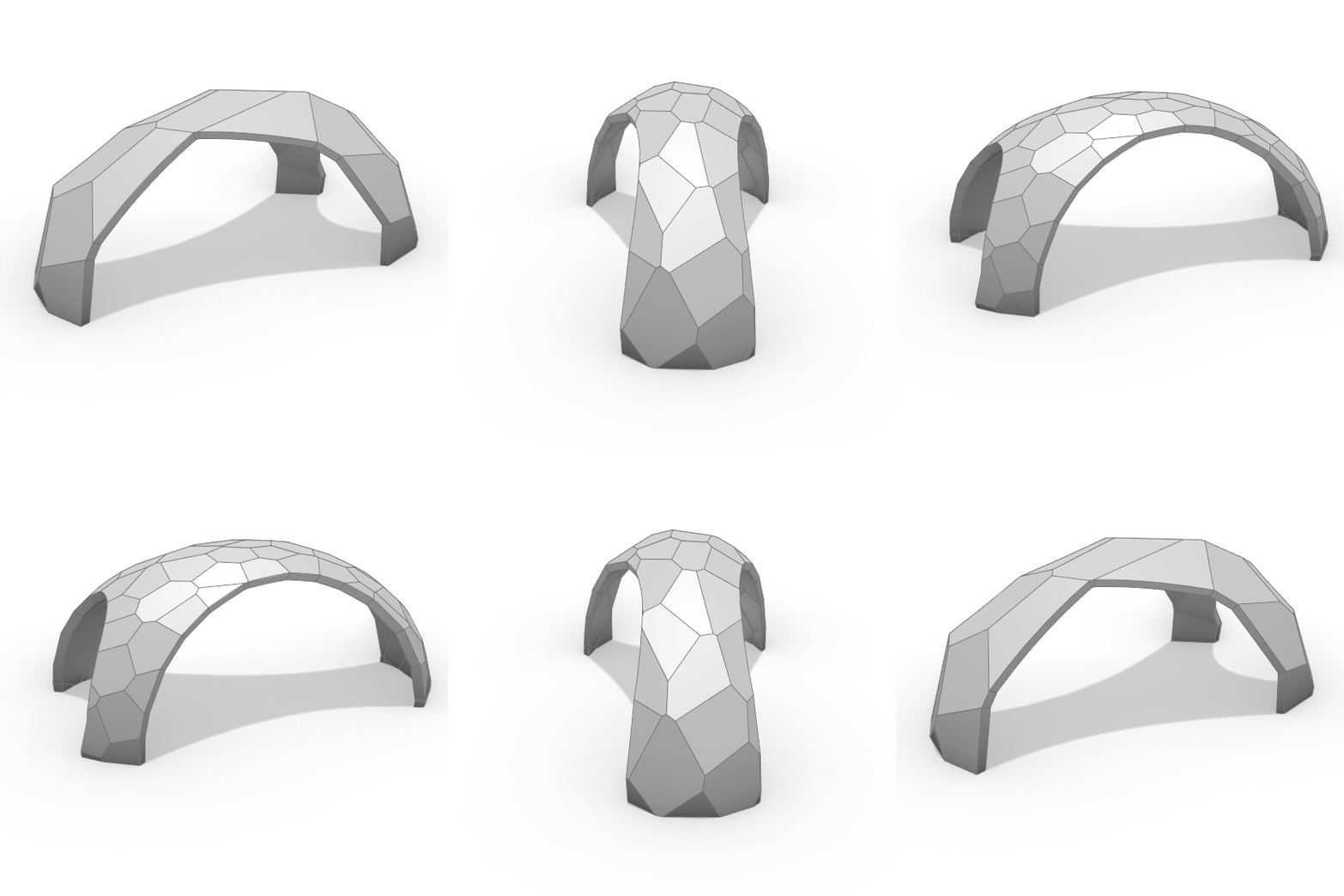
This Grasshopper definition generates Turtle Pavilion designs with several input parameters. The number of panels, dimension factors in x, y, and z, and the thickness of the blocks are the parameters. It is possible to create a spherical pavilion or an ellipsoidal one and explore many design alternatives. Also, you can set new solids instead of the default ones in the B input of the Boolean Difference to create custom macro forms. The resulting blocks are closed polysurfaces. Therefore, they are ready for 3d printing or molding. I made the definition with the help of the native Grasshopper components in Rhinoceros 7. So, no external add-on is necessary.

Cite this post
Related Posts
Quad Tiling on Double Curvature
April 3, 2024
It is not possible to cover a double curvature surface with planar quads. Here is one method that overcomes quad tiling on double curvature by pulling one vertex of the quads to the plane defined by the other three. This method was used in architecture on several occasions such as the exterior facade of The Yas Hotel, designed by Asymptote Architecture in 2009. The same approach is also evident in the roof design covering the central courtyard of the Smithsonian…
Fibonacci Dome
March 1, 2024
This is the continuation of my previous study on the Fibonacci lattice on a spherical surface, creating a Fibonacci Dome structure. The panelization of curved forms with flat surfaces has been a favorite topic in architectural geometry. The trigonometric layout of the Fibonacci sequence generates a spherical formation, while the Faceted Dome component handles planarity. Here, I further enhanced the previous code into a pavilion design. The essential part of the code is about the placement of points on the half…
Rhombille Tiling on Surface
June 13, 2023
This is an update on my 2012 exercise on rhombille tiling. This reminded me of the old-school subdivisions of surfaces again after 11 years. It was while reading about rhombic dodecahedron (the stackable solid), that I came across this cute tiling. It’s quite simple, just a hexagonal grid with a special reconstruction. I decided to recreate it by using well-known native Grasshopper components. I animated the result with a variation of the Breaststroke surface function (described here). Then I reconstructed…
Defective Use of Algorithms: TPI Disability
June 24, 2013
This is based on my failure of creating an optimum solution for planar polygonal subdivisions. There is a method called Tangent Plane Intersection (TPI), explained briefly here (sometimes similar algorithms are called “planar remeshing” and “variational shape approximation”) which is effectively used in the Trada pavilion (here). I tried to implement a similar method using only native Grasshopper components and no recursion, but it quickly became much more complicated than I thought. It was based on the simple idea that…
Quadrilateral Surface Tessellation
April 9, 2012
As far as I understood, it is impossible to physically construct double-curved surfaces from quadrilateral and planar faces. This definition tries to find an optimized alternative to this problem. Any surface, single or double curved, is divided into standard sub surfaces. But this time, those surfaces are treated as planar surfaces, therefore one corner is moved to meet this requirement. The output consists of only planar surfaces ready for fabrication. There are potential improvements to this definition such as finding…