designcoding
About Table of Contents Keywords Monthly Archive
Support designcoding!

#unrolling

14 posts

Modeling and Unrolling Truncated Tetrahedron

March 10, 2024
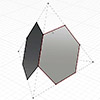
Truncation refers to the process of shortening something by removing parts. You can apply truncation to numbers, text, or data in various contexts. A truncated polyhedron is a geometric solid formed by truncating the vertices of a regular polyhedron. Truncation involves cutting off the corners or vertices of the polyhedron in such a way that the original faces become polygons with new edges. This process creates new faces at the truncated vertices. It often results in a shape that is…
Polyhedra Unroller with Flaps

December 22, 2023

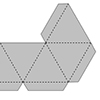
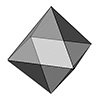
The Polyhedra Unroller with Flaps is a simple tool I developed for the obvious purpose. It picks any polyhedra (closed polysurface) from the user and unrolls it flat on the XY plane. This part is easy because a short Python script is sufficient. The important function of the script is the generation of the production drawings from the unrolled net. It means, the generation of the flaps. Here, the continuous lines represent the cutting paths and the dashed lines represent…

Drawing and Unrolling Octahedron

December 29, 2011

An octahedron is a polyhedron and platonic solid with 8 faces of identical equilateral triangles. In this post, I will try to explain the drawing and unrolling process of the octahedron. It has a close relationship with the cube as it’s dual. In order to construct an octahedron, we first have to create a square. The main problem of drawing the square is determining the right angle (perpendicular axis) to any point in Euclidean space. We’ll draw it here as…

Dodecahedron: Drawing and Unrolling

December 23, 2011

The dodecahedron is a Platonic Solid with 12 equilateral pentagonal faces. It has a close relationship with its 20-sided dual, Icosahedron. Mete Tüneri showed the following method of Dodecahedron construction, using only distances, corners of the pentagon, and a visionary equilateral triangle underneath. We’ll construct Dodecahedron, assuming that we’ve drawn an initial equilateral pentagon. We need to find out the pentagon’s angle of 3d rotation. First, put spheres at points a and c, with a radius of a to c. The…

« 1 2
  • Chapters

    • Algorithms
    • Discourses
    • Fabrications
    • Studios
  • Explore

    • All Keywords
    • Table of Contents
    • Monthly Archive
    • #anemone
    • #enneahedron
    • #concrete
    • #rhombus
    • #tiling
    • #text
    • #truncated
    • #geodesic
    • #unity
    • #hexagon
    • #platonic-solid
    • #tree
    • #designcoding
    • #aperiodic
    • #photoshop
    • #visualization
    • #islamic-pattern
    • #hoopsnake
    • #solar-analysis
    • #cairo-pentagonal
  • Search

  • Support designcoding!

  • Enjoying designcoding? Support me on Patreon to keep it growing. Thank you!

  • copyright 2026 designcoding.net | about | privacy policy | end user license agreement