
Hyperbolic Paraboloid Surface
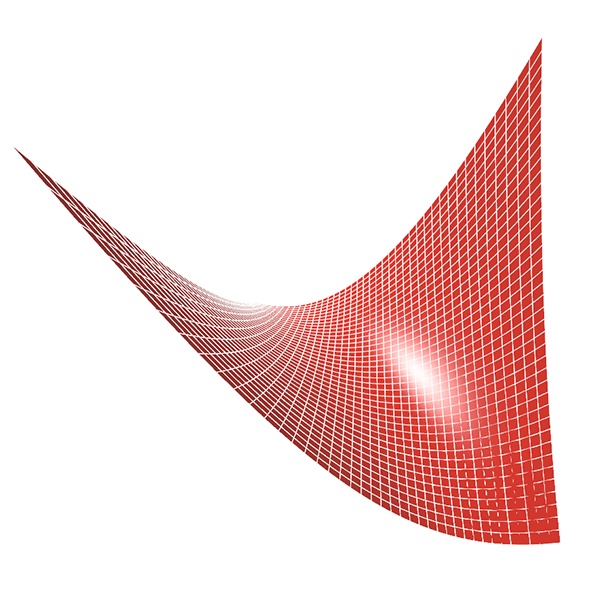
Since the mid-20th century, the hyperbolic paraboloid surface has been one of the most popular mathematical forms for architects. Named Hypar in short, this is the Quadric Surface equation of the Hyperbolic Paraboloid. Erik Demaine summarizes several examples from architecture such as the roof of the Girls’ Grammar School in London (designed by Chamberlin, Powell, and Bonn), the Philips pavilion at the 1958 Brussels exhibition designed by Le Corbusier, and finally, Frei Otto illustrated and analyzed a grid of connecting 4-hats in the 1969 book Tensile Structures. After my initial model in 2011, it was a pleasure for me to model this old math shape again. I added a planar rotation in the parametric model so that it turns without changing the overall shape. At some point (actually at degree “pi”) it creates the other famous z=xy surface known in architecture. We should also deal with that.
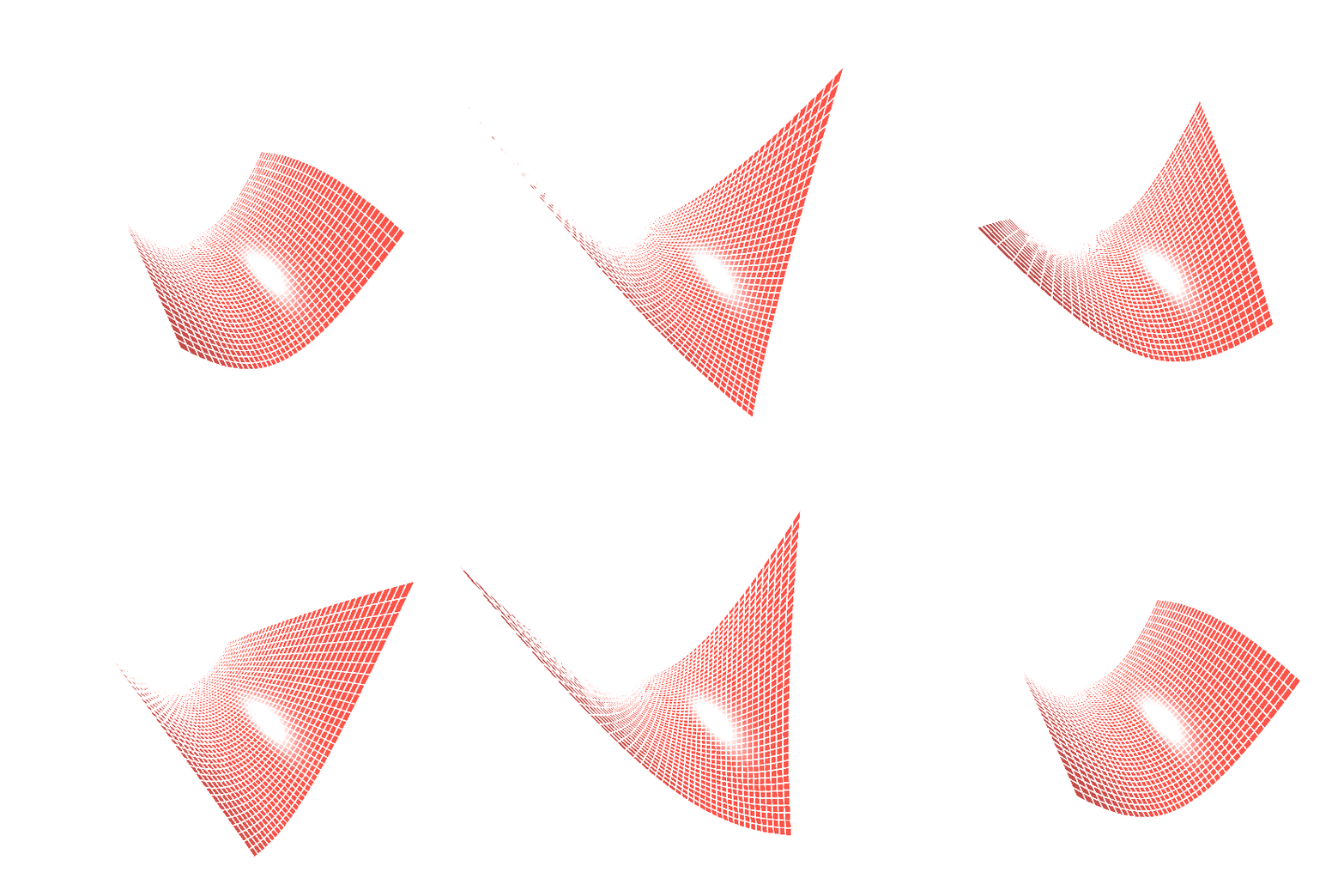
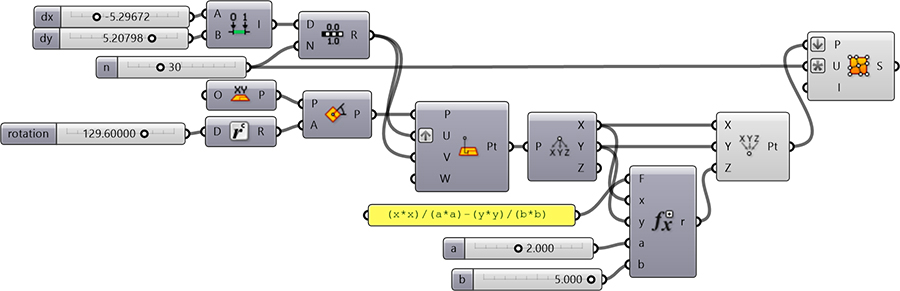
This Grasshopper definition generates Hyperbolic Paraboloid surfaces with given input parameters. It is an educational and exploratory code to learn Grasshopper and generate interesting designs with it. The inputs of the definition control the surface function and the rotation parameter for animation purposes. The output of the code is a single surface in Rhinoceros. Therefore, it is ready for further investigation and modeling. The code is using native Grasshopper components. Thus, no add-ons are necessary for it to work.
Cite this post
Related Posts
Modeling Cylinder Hypar
December 16, 2024
A “hypar” is short for a hyperbolic paraboloid, a double-curved, saddle-shaped surface often used in architecture and structural design due to its unique geometric properties. It is a ruled surface, meaning it can be constructed entirely with straight lines, despite its curved appearance. In this short tutorial video, I am building a beginner-level 3D pattern that resembles the hypar surface. This is a basic drawing exercise to control the viewport and place primitive objects precisely. Thus, more advanced tutorials would…
Field Deformation
October 8, 2026
Ever since I restructured designcoding, I’m still sorting through the trash folder. All 580 posts published on the blog have been reviewed, and their files have been uploaded as open source. The mysterious trash folder, where I couldn’t even tell where things belonged, is shrinking fast. While checking this folder yesterday, I found a video. This is probably a simple tutorial I prepared about 10 years ago for the parametric modeling elective course (probably related to this 2012 post). The…
Quad Tiling on Double Curvature
April 3, 2024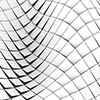
It is not possible to cover a double curvature surface with planar quads. Here is one method that overcomes quad tiling on double curvature by pulling one vertex of the quads to the plane defined by the other three. This method was used in architecture on several occasions such as the exterior facade of The Yas Hotel, designed by Asymptote Architecture in 2009. The same approach is also evident in the roof design covering the central courtyard of the Smithsonian…
B-Spline Construction
January 25, 2024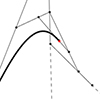
I have been studying the Bezier-De Casteljau algorithm for several years. Last week, I finally managed to understand and implement B-Spline Construction in Rhino and Grasshopper Python code, using the Cox-De Boor algorithm. This algorithm calculates the effect of control points on a B-Spline with many control points. After this, I am not limited to the degree+1 control points. This animation shows both algorithms working together. This Rhino Python code in a Grasshopper definition can handle three tasks. The first…
Folding Experiments: Basics (1)
December 6, 2022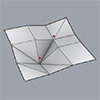
We will try to create collapsible structures in this new series called Folding Experiments. In this example, we will be using Grasshopper and Kangaroo components to understand the Folding Experiments: Basics first. Like other projects, this is a Parametric Modeling course exercise that usually includes primary Grasshopper usage. In our first example, we will try to fold a mesh object. To be able to fold a surface like origami, we need to define the folding creases and faces. The most…